
Ford Mustang (1999-2004) Service Manual: Torque Converter (Description and Operation)
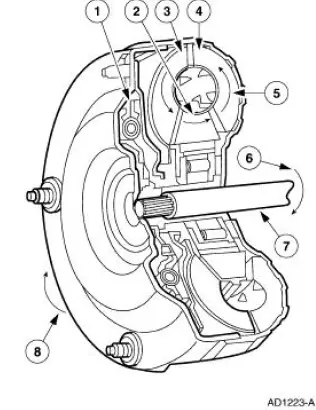
The torque converter transmits and multiplies torque. The torque converter is a four-element device:
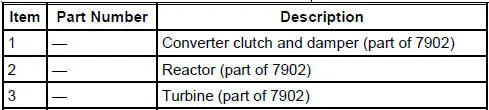
- impeller assembly
- turbine assembly
- reactor assembly
- clutch and damper assembly
The standard torque converter components operate as follows:
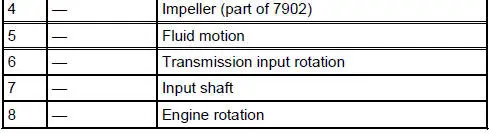
- Rotation of the converter housing and impeller set the fluid in motion.
- The turbine reacts to the fluid motion from the impeller, transferring rotation to the geartrain through the input shaft.
- The reactor redirects fluid going back into the impeller, allowing for torque multiplication.
- The clutch and damper assembly dampens powertrain torsional vibration and provides a direct mechanical connection for improved efficiency.
- Power is transmitted from the torque converter to the planetary gearsets and other components through the input shaft.
 Shift Patterns
Upshifts
Transmission upshifting is controlled by the powertrain control
module (PCM). The PCM receives
inputs from various engine or vehicle sensors and driver demands to
control shift sche ...
 Geartrain
Power is transmitted from the torque converter to the Ravigneaux
geartrain components through the
input shaft and forward clutch cylinder.
The geartrain contains a Ravigneaux planetary set ...
Other materials:
Connecting Rod - Twist
1. Measure the connecting rod twist on a suitable alignment fixture.
Follow the instructions of the
fixture manufacturer. Verify the measurement is within specification.
Refer to the appropriate section in Group for the procedure.
If out of specificat ...
Exhaust Manifold RH
Removal and Installation
1. Disconnect the battery negative cable. For additional information,
refer to Section.
2. Remove the air cleaner outlet pipe. For additional information, refer to
Section.
3. Disconnect the differential pressure feedback exha ...
Crankshaft Runout
Special Tool(s)
Dial Indicator Gauge with
Holding Fixture
100-002 (TOOL-4201-C) or
equivalent
1. NOTE: Crankshaft main bearing journals must be within
specifications before checking runout.
Use the Dial Indicator Gauge with Holding Fixtur ...
