
Ford Mustang (1999-2004) Service Manual: Fuel System (Description and Operation)
Component Location
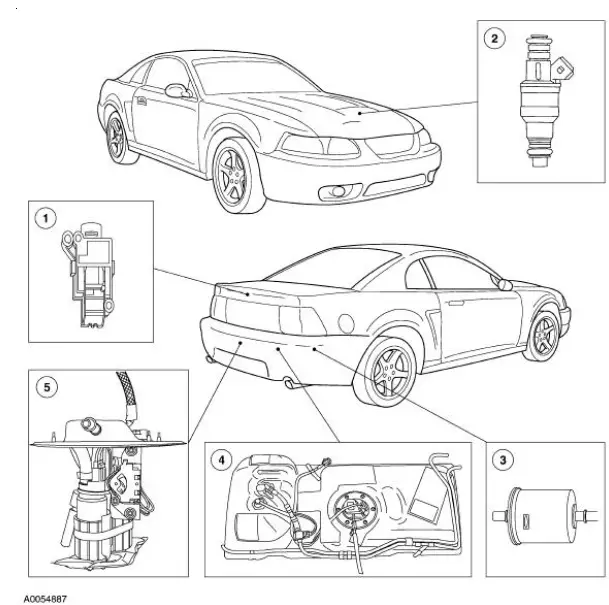
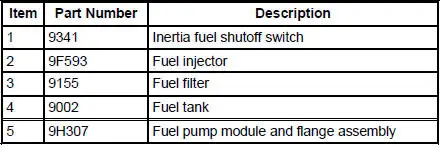
WARNING: Do not smoke or carry lighted tobacco or open flame of any type when working on or near any fuel-related components. Highly flammable mixtures are always present and may be ignited, resulting in possible personal injury.
The vehicle:
- uses a returnless fuel system.
- is equipped with a multiport fuel injection (MFI) system.
- uses separately controlled fuel injectors (9F593) for each cylinder. The fuel injectors are mounted to the intake manifold.
- fuel injectors are supplied with pressurized fuel from the fuel pump (9350) through the fuel injection supply manifold (9D280).
- fuel injection supply manifold is controlled by the electronic fuel delivery module which is enabled by the powertrain control module (PCM) (12A650).
Fuel System
Refer to the Powertrain Control/Emissions Diagnosis (PC/ED) manual.
 Fuel System - General Information
General Specifications
...
 Pressure Relief
Special Tool(s)
Fuel Pressure Gauge
310-012 (T80L-9974-B)
WARNING: Do not smoke or carry lighted tobacco or open flame of any
type when
working on or near any fuel-related components. ...
Other materials:
Vehicle Certification (VC) Label Locator
The upper portion of the vehicle certification (VC) label contains the
manufacturer name, the month
and year of manufacture, the certification statement and the VIN. It also
includes gross vehicle weight
ratings (GVWR). The VC label is located on the left- ...
Water Pump - 3.8L
Material
Item
Specification
Motorcraft Premium Gold
Engine Coolant
VC-7-A (in Oregon VC-7-B)
(yellow color)
WSS-M97B51-
A1
Removal and Installation
1. Drain the engine coolant. For additional information, refer to Cooling
System Dra ...
Engine Ignition (Description and Operation)
Eight separate ignition coils (12029):
are mounted directly above each spark plug (12405).
are controlled by the powertrain control module (PCM) for correct
firing sequence.
The spark plug:
changes the high voltage pulse into a spark which igni ...
