
Ford Mustang (1999-2004) Service Manual: Master Cylinder Priming - 4.6L
1. CAUTION: Use only bleed screws on the engine side of the brake master cylinder (2140). The hydro-boost bleed screw, located near the dash on the hydro-booster casting, is for the booster cavity filled with power steering fluid, not brake fluid.
Connect a clear waste line to the bleed screw closet to the booster first and the other end in a container partially filled with recommended brake fluid.
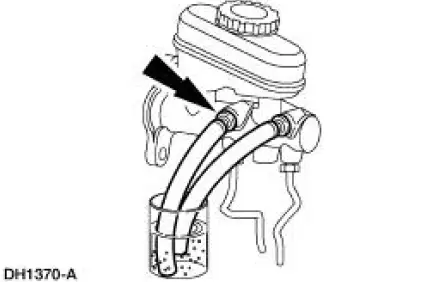
2. Open the bleeder screw, have an assistant push the brake pedal down slowly through full travel, close the bleeder screw, then return brake pedal slowly to full released position. Wait five seconds, then repeat operation until air bubbles cease to appear.
3. Repeat Step 2 for bleeder screw farthest from hydro-booster.
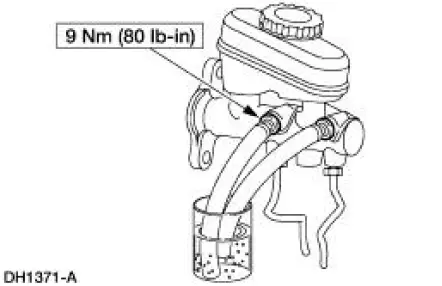
 Master Cylinder Priming - In-Vehicle or Bench
WARNING: Brake fluid contains polyglycol ethers and polyglycols. Avoid
contact with
eyes. Wash hands thoroughly after handling. If brake fluid contacts eyes, flush
eyes with
running water for 15 min ...
 Four Wheel Anti-Lock Brake System (4WABS) Hydraulic Control Unit (HCU)
NOTE: This procedure only needs to be performed if the 4-wheel
anti-lock brake (4WABS) hydraulic
control unit (HCU) has been installed new or if the HCU lines have been
opened.
1. Clean all ...
Other materials:
Door Speaker - Lower
Removal and Installation
1. Remove the front door trim panel (239420). For additional
information, refer to Section
2. Remove the speaker (18808).
1. Remove the screws.
2. Disconnect the electrical connector.
3. Remove the speaker.
3. ...
Transmission Fluid Cooler
CAUTION: Whenever a transmission has been disassembled to install
new parts, the
cooler bypass valve (CBV), all transmission fluid coolers (in tank and
auxiliary) and
transmission fluid cooler lines must be cleaned and backflushed. Use a
suitable the t ...
Washer fluid check
WARNING: If you operate your vehicle in temperatures below
40°F (5°C), use washer fluid with antifreeze protection. Failure
to use washer fluid with antifreeze protection in cold weather could
result in impaired windshield vision and increase the risk of inj ...
