
Ford Mustang (1999-2004) Service Manual: Parking Brake Cable Tension Release
1. CAUTION: If any component in the parking brake system requires repair or if the rear axle housing (4010) is removed, the cable tension must be released.
Place the parking brake control (2780) in the released position.
2. Remove the console.
3. With an assistant inside the vehicle, raise and support the vehicle.
4. Pull the parking brake cable and equalizer rearward.
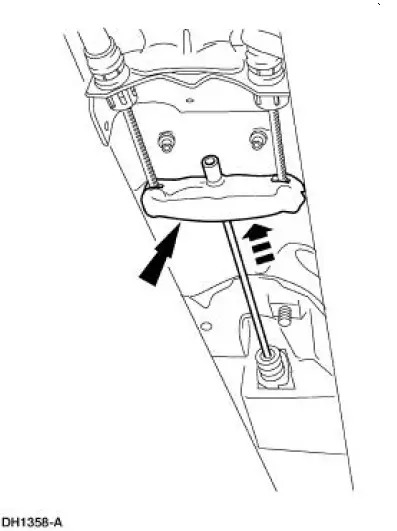
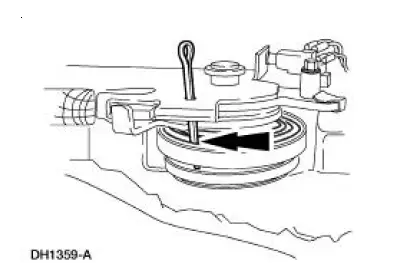
5. CAUTION: Do not remove the steel pin until the parking brake cable and equalizer/rear cable and conduits are connected to the parking brake control. Pin removal releases the tension in the ratchet wheel causing the spring to unwind and release tension.
Insert a steel pin through holes in the lever to the ratchet wheel.
 Parking Brake (Diagnosis and Testing)
Inspection and Verification
1. Verify the customer's concern by operating the parking brake system to
duplicate the condition.
2. Inspect to determine if one of the following mechanical or electrica ...
 Parking Brake Control
Removal
1. CAUTION: If any component in the parking brake system requires
repair or if the
rear axle housing (4010) is removed, the cable tension must be released.
Place the parking brake control (2 ...
Other materials:
Brake Disc Machining
Special Tool(s)
Gauge, Clutch Housing
308-021 (T75L-4201-A)
Dial Indicator Gauge with
Holding Fixture
100-002 (TOOL-4201-C) or
equivalent
Material
Item
Specification
Metal Surface Cleaner
F4AZ-19A536-RA or equiv ...
Air Intake Scoop Bracket
Removal and Installation
1. Remove the air intake scoop. For additional information, refer to Air
Intake Scoop in this section.
2. Remove the air intake scoop bracket nut at the throttle body.
3. Remove the exhaust gas recirculation (EGR) vacuum regulat ...
Installation
1. NOTE: A new torque converter drain plug must be used.
Install the torque converter drain plug.
2. Install the torque converter housing plug.
3. CAUTION: If installing a new filter, and the seal remains in the
main control bore,
carefully use a small ...
