
Ford Mustang (2005-2014) Owners Manual: Child seat positioning
WARNING: Airbags can kill or injure a child in a child seat.
Never place a rear-facing child seat in front of an active airbag.
If you must use a forward-facing child seat in the front seat, move the vehicle seat upon which the child seat is installed all the way back.
When possible, all children age 12 and under should be properly restrained in a rear seating position. If all children cannot be seated and restrained properly in a rear seating position, properly restrain the largest child in the front seat.
WARNING: Always carefully follow the instructions and warnings provided by the manufacturer of any child restraint to determine if the restraint device is appropriate for your child’s size, height, weight, or age. Follow the child restraint manufacturer’s instructions and warnings provided for installation and use in conjunction with the instructions and warnings provided by your vehicle manufacturer. A safety seat that is improperly installed or utilized, is inappropriate for your child’s height, age or weight, or does not properly fit the child, may increase the risk of serious injury or death.
WARNING: Never let a passenger hold a child on his or her lap while your vehicle is moving. The passenger cannot protect the child from injury in a crash, which may result in serious injury or death.
WARNING: Never use pillows, books, or towels to boost a child.
They can slide around and increase the likelihood of injury or death in a crash.
WARNING: Always restrain an unoccupied child seat or booster seat. These objects may become projectiles in a crash or sudden stop, which may increase the risk of serious injury.
WARNING: Never place, or allow a child to place, the shoulder belt under a child’s arm or behind the back because it reduces the protection for the upper part of the body and may increase the risk of injury or death in a crash.
WARNING: To avoid risk of injury, do not leave children, unreliable adults, or pets unattended in your vehicle.
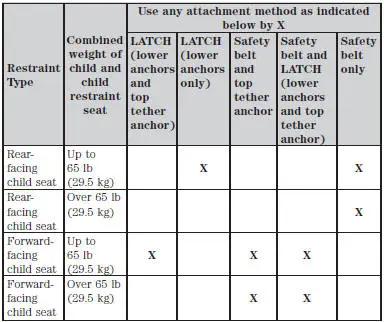
Note: The child seat must rest tightly against the vehicle seat upon which it is installed. See the Seats chapter for information on head restraints.
 Child Safety
GENERAL INFORMATION
See the following sections for directions on how to properly use safety
restraints for children.
WARNING: Always make sure your child is secured properly in
a device that is approp ...
 Booster seats
WARNING: Never place, or allow a child to place, the shoulder
belt under a child’s arm or behind the back because it reduces
the protection for the upper part of the body and may increase the risk
o ...
Other materials:
Glass, Frames and Mechanisms (Diagnosis and Testing)
Refer to Wiring Diagrams Cell 100 , Power Windows for schematic and
connector information.
Refer to Wiring Diagrams Cell 56 , Rear Window Defrost for schematic and
connector information.
Special Tool(s)
Worldwide Diagnostic System
(WDS)
4 ...
Booster seats
WARNING: Never place, or allow a child to place, the shoulder
belt under a child’s arm or behind the back because it reduces
the protection for the upper part of the body and may increase the risk
of injury or death in a crash.
Use a belt-positioning booster ...
Navigation system
Your navigation system allows you to set a destination by using your
touchscreen or voice commands.
The navigation system contains map coverage for the United States,
Puerto Rico and U.S. Virgin Islands, Canada and Mexico.
Disclaimer
A disclaimer appears onc ...
