
Ford Mustang (1999-2004) Service Manual: Acceleration Control (Description and Operation)
Component Locations
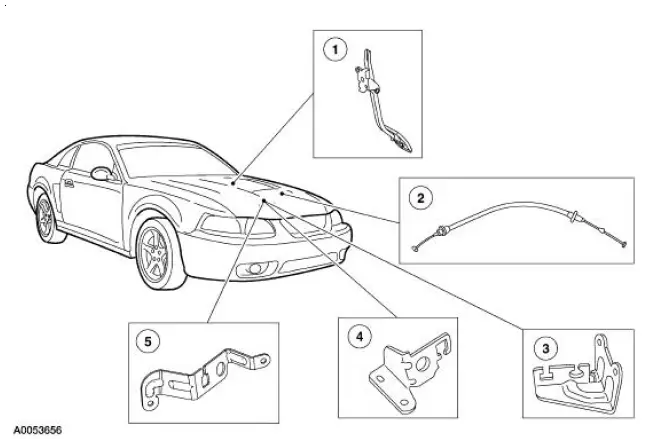
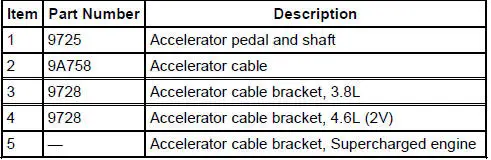
The throttle is controlled by the accelerator cable which is connected to the accelerator pedal and shaft.
- The accelerator pedal and shaft should travel smoothly from the idle to the wide-open throttle (WOT) positions. Hesitation on return or prevention of return to the idle position must not occur.
- Surrounding components such as wiring, hoses, sound insulator and floor covering must not contact the sliding inner member of the accelerator cable or the accelerator pedal and shaft.
- The sliding inner member of the accelerator cable should not be lubricated and is not serviceable.

 Acceleration Control (Diagnosis and Testing)
Inspection and Verification
1. Verify the customer's concern by operating the acceleration control system
to duplicate the
condition.
2. Inspect to determine if any of the following mechanical conce ...
Other materials:
Disassembly
1. WARNING: To avoid risk of serious personal injury, follow all
warnings, cautions,
notes and instructions in the driver air bag removal and installation procedure.
Remove the steering column (3C529). For additional information, refer to Column
in this
s ...
Camshaft Runout
Special Tool(s)
Dial Indicator Gauge with
Holding Fixture
100-002 (TOOL-4201-C) or
equivalent
1. NOTE: Camshaft journals must be within specifications before
checking runout.
Use a Dial Indicator Gauge with Holding Fixture to measure the ...
Battery (Diagnosis and Testing)
Special Tool(s)
Micro 490 Digital Battery
Analyzer
162-00004
Inspection and Verification
1. Verify the customer concern by operating the system.
2. Visually inspect for obvious signs of mechanical or electrical
damage.
Visual Inspecti ...
