
Ford Mustang (1999-2004) Service Manual: Brake Booster - Vacuum (Description and Operation)
Power Brake Booster
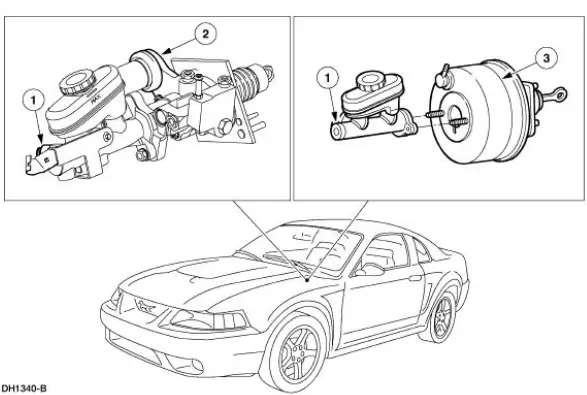
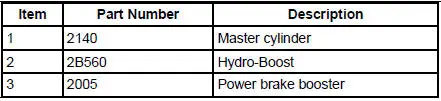
The vacuum type power brake booster (2005):
- is a dual diaphragm, vacuum assisted power brake booster
- reduces brake pedal force and travel distance.
- is located on the LH side of the bulkhead in the engine compartment, between the brake pedal (2455) and the brake master cylinder (2140).
- is divided into separate chambers by the diaphragms.
- will not operate if vacuum is restricted or if any of the vacuum related power brake components fail.
- is installed as an assembly.
If the power assist fails, the brake system will continue to operate with increased brake pedal effort.
Hose and Check Valve
The power brake booster check valve (2365):
- is located on the front of the power brake booster.
- is installed separately; (install a new grommet when installing a new check valve).
- is positioned between the power brake booster and the power brake booster hose.
- closes when the engine is turned off.
- in the closed position, traps engine vacuum in the power brake booster
- retains vacuum to provide several power assisted brake applications with the engine off.
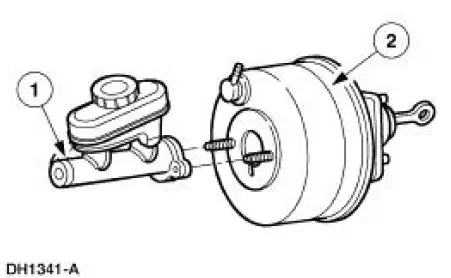

 Power Brake Actuation
Torque Specifications
...
 Brake Booster - Hydro-Boost (Description and Operation)
The Hydro-Boost brake booster is a hydraulically operated brake booster
powered by the power
steering pump (3A674). The power steering pump provides the fluid pressure to
operate both the
power brak ...
Other materials:
Piston - Selection
NOTE: The cylinder bore must be within the specifications for
taper and out-of-round before fitting a
piston.
1. Select a piston size based on the cylinder bore.
2. NOTE: For precision fit, new pistons are divided into three
categories within each size ...
Battery Disconnect
WARNING: Batteries normally produce explosive gases which can
cause personal injury.
Therefore, do not allow flames, sparks or lighted substances to come
near the battery, always
shield your face and protect your eyes. Always provide ventilation.
...
Disassembly
1. NOTE: Mark the position of each gear shifter fork (7230).
Place the gear shift plates (7N232) and the gear selector interlock sleeve
(7K201) in the neutral
position to center the gear shift plates and the selector body (7302).
2. Rotate the main shif ...
