
Ford Mustang (1999-2004) Service Manual: Crankshaft Runout
Special Tool(s)
|
|
Dial Indicator Gauge with Holding Fixture 100-002 (TOOL-4201-C) or equivalent |
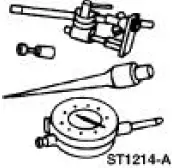
1. NOTE: Crankshaft main bearing journals must be within specifications before checking runout.
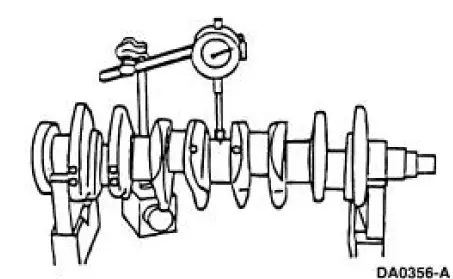
Use the Dial Indicator Gauge with Holding Fixture to measure the crankshaft runout.
- Refer to the appropriate section in Group 303 for the procedure.
- Rotate the crankshaft and subtract the lowest dial indicator reading from the highest dial indicator reading to figure the crankshaft runout. If it is out of specification, install new components as necessary. Refer to the appropriate section in Group 303 for the procedure.
 Crankshaft End Play
Special Tool(s)
Dial Indicator Gauge with
Holding Fixture
100-002 (TOOL-4201-C) or
equivalent
1. Measure the crankshaft end play. Use a Dial Indicator Gauge with Holding
Fixture t ...
 Crankshaft - Connecting Rod Journal Taper, Out of Round
1. Measure the crankshaft connecting rod journal diameters in two
directions perpendicular to one
another at each end of the connecting rod journal. The difference in the
measurements from
one e ...
Other materials:
Connecting Rod - Bushing Diameter
1. Measure the inner diameter of the connecting rod bushing, if equipped.
Verify the diameter is
within specification.
Refer to the appropriate section in Group for the procedure.
If out of specification, install new components as necessary. Refer
...
Fuel System (Description and Operation)
Component Location
WARNING: Do not smoke or carry lighted tobacco or open flame of any
type when
working on or near any fuel-related components. Highly flammable mixtures are
always present
and may be ignited, resulting in possible personal injury ...
Electronic Vibration Analyzer (EVA)
The EVA is a hand-held electronic diagnostic tool which will assist in
locating the source of
unacceptable vibrations. The vibration sensor can be remotely mounted anywhere
in the vehicle for
testing purposes. The unit displays the three most common vibratio ...
