
Ford Mustang (1999-2004) Service Manual: Driveshaft (Description and Operation)
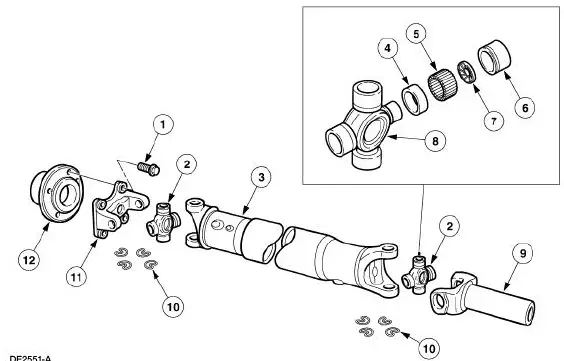
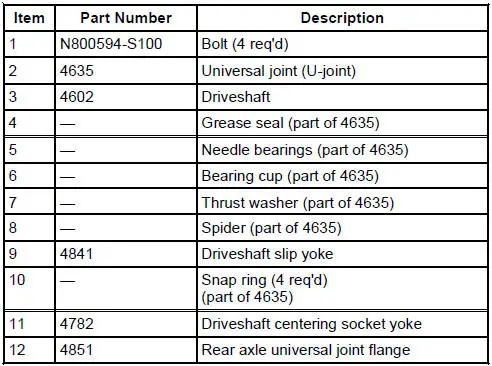
NOTE: All driveshaft assemblies are balanced. If undercoating the vehicle, protect the driveshaft to prevent overspray of any undercoating material.
The driveshaft has the following features:
- A tubular shaft used to transfer engine torque from the transmission output shaft to the differential in the rear axle housing, which transmits torque through the axle shafts to the drive wheels.
- Consists of two single-cardan universal joints, a driveshaft slip yoke, a welded tube assembly and a driveshaft centering socket yoke.
- The splined driveshaft slip yoke permits the driveshaft to move forward and rearward on the transmission output shaft during drivetrain movement and during driveshaft removal and installation.
 Driveshaft
Torque Specifications
Description
Nm
lb-ft
Pinion flange bolts
112
83
...
 Universal Joints
The universal joints are:
lubed-for-life design and require no lubrication.
equipped with nylon thrust washers, located at each base of the bearing
cup, which control end
play, position the need ...
Other materials:
Door Speaker - Upper
Removal and Installation
1. Remove the front door trim panels (239420). For additional
information, refer to Section
2. Remove the upper speaker access cover.
3. Remove the upper speaker housing.
1. Remove the screw.
2. Remove the upper spea ...
Key Programming - Erase All Key Codes and Program Two
Keys
Special Tool(s)
Worldwide Diagnostic System
(WDS)
418-F224,
New Generation STAR (NGS)
Tester
418-F052 or equivalent
diagnostic tool
NOTE: This procedure is used when a customer needs keys programmed
into the system and does
not have ...
Transmission (Assembly)
Special Tool(s)
Dial Indicator Gauge with
Holding Fixture
100-002 (TOOL-4201-C) or
equivalent
Holding Fixture, Transmission
307-003 (T57L-500-B)
Remover/Installer, Bearing
Tube
308-025 (T75L-7025-C)
In ...
