
Ford Mustang (1999-2004) Service Manual: Starter Motor - 3.8L
Removal
WARNING: When servicing starter motor (11002) or carrying out other underhood work in the vicinity of the starter motor, be aware that the heavy gauge battery input lead at the starter solenoid (11390) is "electrically hot" at all times. A protective cap or boot is provided over this terminal that must be installed after servicing. Be sure to disconnect the battery negative cable before servicing the starter. Failure to follow these instructions may result in personal injury.
WARNING: When working in area of the starter motor, be careful to avoid touching hot exhaust components. Failure to follow these instructions may result in personal injury.
NOTE: When working on the starter system, make sure the anti-theft system is deactivated (if equipped.)
1. Disconnect the battery ground cable. For additional information, refer to Section.
2. Raise and support the vehicle. For additional information, refer to Section.
3. Remove the ground cable nut.
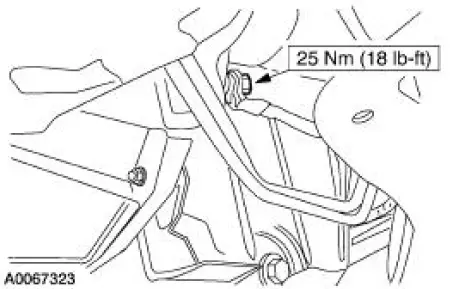
4. Remove the cap.
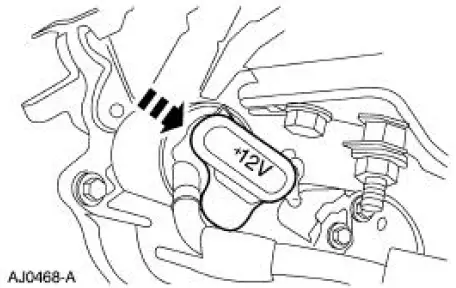
5. Remove the nuts and position aside the wires.
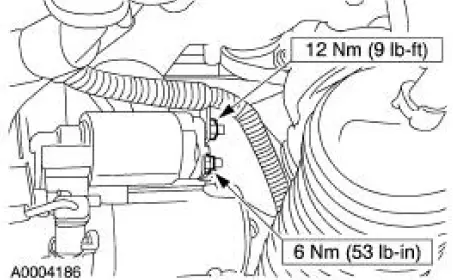
6. Remove the bolts and the starter motor.
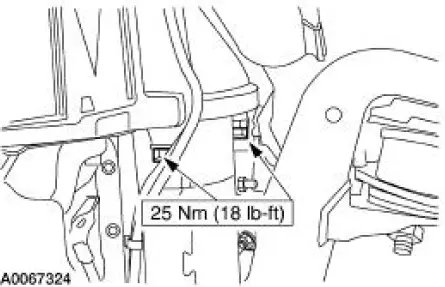
Installation
1. To install, reverse the removal procedure.
 Relay Switch
1. Disconnect the battery ground cable. For additional information, refer
to Section.
2. Remove the power distribution box cover.
3. Remove the starter relay from the power distribution box.
I ...
 Starter Motor - 4.6L
Removal
WARNING: When servicing starter motor (11002) or carrying out other
underhood work in
the vicinity of the starter motor, be aware that the heavy gauge battery
input lead at the starter
...
Other materials:
Idle Air Control (IAC) Valve - 4.6L (2V)
Removal
1. Disconnect the battery ground cable. For additional information,
refer to Section.
2. NOTE: Discard the idle air control (IAC) valve gasket.
Remove the IAC valve.
Disconnect the connector.
Disconnect the hose.
Remove the bolts, ...
Assembly
Initial assembly
1. Coat the new differential drive pinion bearing cup(s) with lubricant.
Use SAE 75W-140 High Performance Rear Axle Lubricant F1TZ-19580-B or
equivalent
meeting Ford specification WSL-M2C192-A.
2. Using the special tool, install the diff ...
Interior Trim Codes
The interior trim codes are listed below. The first letter/number is for the
interior fabric. The second
letter is for the interior color.
9 - Quantum/Rhodes cloth (base coupe)
A - Link weave cloth (Mach One)
M - Nudo Leather (Cobra)
T - Lea cloth with ...
