
Ford Mustang (1999-2004) Service Manual: Supercharger Cooling System Flushing
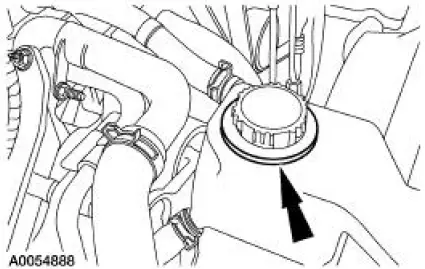
1. WARNING: Never remove the pressure relief cap while the engine is operating or when the cooling system is hot. Failure to follow these instructions can result in damage to the cooling system or engine or personal injury. To avoid having scalding hot coolant or steam blow out of the degas bottle when removing the pressure relief cap, wait until the engine has cooled, then wrap a thick cloth around the pressure relief cap and turn it slowly. Step back while the pressure is released from the cooling system. when you are sure all the pressure has been released, (still with a cloth) turn and remove the pressure relief cap.
Once pressure is released, remove the pressure relief cap.
2. Drain the cooling system. For additional information, refer to Supercharger Cooling System Draining, Filling and Bleeding in this section.
3. NOTE: Refer to the cooling system flusher manufacturer's operating instructions for specific vehicle hook-up.
Using an appropriate cooling system flusher, flush the intercooler cooling system.
Use Premium Cooling System Flush VC-1 meeting Ford specification ESR-M14P7-A.
4. Fill the cooling system. For additional information, refer to Supercharger Cooling System Draining, Filling and Bleeding in this section.
 Supercharger Cooling System Draining, Filling and
Bleeding
Supercharger Cooling System Draining, Filling and
Bleeding
Draining
WARNING: Never remove the pressure relief cap while the engine is
operating or when the
cooling system is hot. Failure to follow these instructions can result in damage
to the cooling
syste ...
 Water Pump
Removal and Installation
1. Disconnect the battery ground cable.
2. Drain the coolant. For additional information, refer to Supercharger Cooling
System Draining,
Filling and Bleeding in this section ...
Other materials:
Installation
1. CAUTION: Do not use metal scrapers, wire brushes, power abrasive
discs or other
abrasive means to clean the sealing surfaces. These tools cause scratches and
gouges
which make leak paths. Use a plastic scraping tool to remove all traces of old
sealant.
...
Opening the convertible top
Note: Do not store articles behind rear seat. Articles stored in the
convertible top stowage compartment may break the rear glass window
when the top is opened.
Note: Opening the convertible top when the top material is wet may
cause mold or mildew.
The conv ...
Transmission Cooling - Integral
This vehicle with an automatic transmission is equipped with an integral
transmission fluid cooler. The
cooler is contained inside of the radiator outlet tank and cannot be serviced
separately. The cooler
transfers heat from the transmission fluid to the eng ...
