
Ford Mustang (1999-2004) Service Manual: Hinge Adjustment
NOTE: The door should be adjusted for even and parallel fit with the body opening and surrounding panels as well as making sure that the anti-chuck pin is not binding on convertible models.
1. Remove the A-pillar lower trim panel.
2. Position the electrical connectors aside.
3. Loosen the lower front door hinge-to-body nut enough to permit movement.
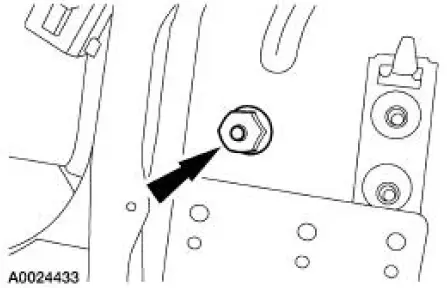
4. Remove the fender. For additional information, refer to Section.
5. Mark the position of the upper and lower front door hinges to the body to use as reference points.
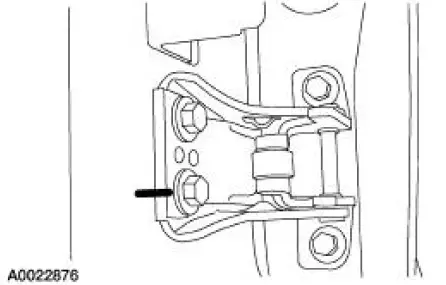
6. Loosen the four upper and lower front door hinge-to-body bolts enough to permit movement.
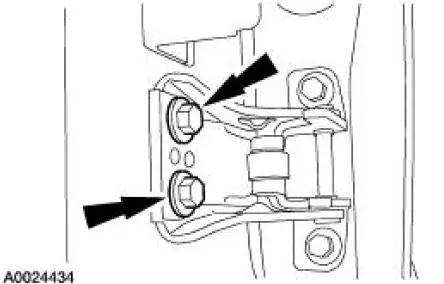
7. Adjust the front door to specification.
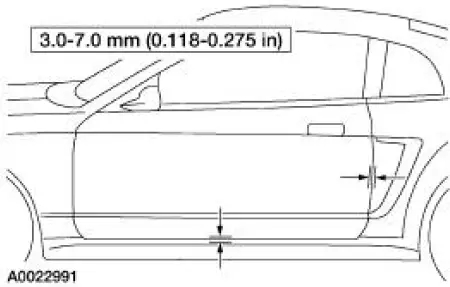
8. NOTE: After adjusting the door hinge, verify that the door can be closed easily and fits tightly.
Tighten the front door hinge to body bolts.
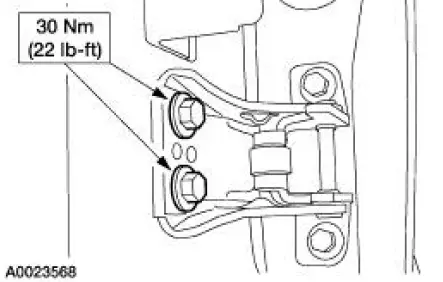
9. Tighten the front door hinge to body nut.
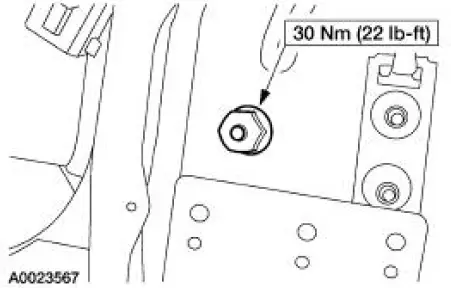
10. Install the electrical connectors.
11. Install the A-pillar lower trim panel.
12. Install the fender. For additional information, refer to Section.
 Body Closures
General Specifications
Torque Specifications
Body Closures
The body closures consist of the following components:
door checks
front door
front door latch strikers
front door hinges ...
 Door Alignment
NOTE: The door should be adjusted for even and parallel fit with the
body opening and surrounding
panels as well as making sure that the anti-chuck pin is not binding on
convertible models.
...
Other materials:
Sensor Indicator - Rear
Special Tool(s)
Pinion Bearing Cone Remover
205-D002 (D79P-4621A)
Axle Bearing/Seal Plate
205-090 (T75L-1165-B)
Sensing Ring Replacer
206-041 (T89P-20202-A)
Removal
1. Remove the rear axle shaft bearing.
2. Using the special ...
General information
WARNING: Driving while distracted can result in loss of vehicle
control, accident and injury. Ford strongly recommends that drivers
use extreme caution when using any device or feature that may take their
focus off the road. Your primary responsibility is the ...
Component Tests
Drive Belt Noise/Flutter
Drive belt chirp occurs due to pulley misalignment or excessive pulley runout.
It can be the result of a
damaged pulley or an incorrectly aligned pulley.
To correct, determine the area where the noise comes from. Check each of the
p ...
