
Ford Mustang (1999-2004) Service Manual: Chuckle
Chuckle that occurs on the coast driving phase is usually caused by excessive clearance between the differential gear hub and the differential case bore.
Damage to a gear tooth on the coast side can cause a noise identical to a chuckle. A very small tooth nick or ridge on the edge of a tooth can cause the noise.
Clean the gear tooth nick or ridge with a small grinding wheel. If the damaged area is larger than 3.2 mm (1/8 inch), install a new gearset.
To check the ring gear and pinion, remove as much lubricant as possible from the gears with clean solvent. Wipe the gears dry or blow them dry with compressed air. Look for scored or damaged teeth.
Also look for cracks or other damage.
If either gear is scored or damaged badly, install a new ring gear and pinion.
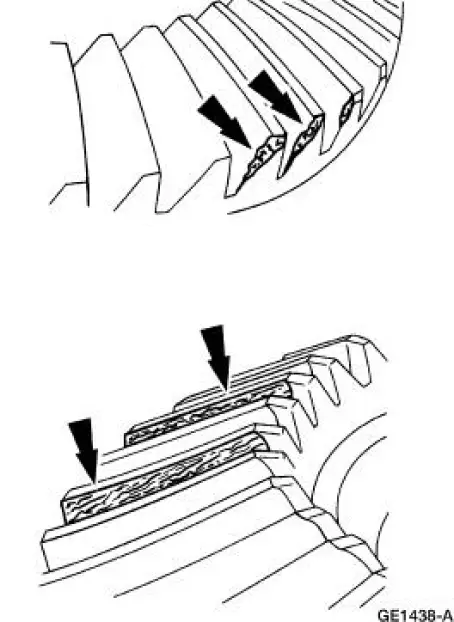
If metal has broken loose, the axle housing must be cleaned to remove particles that will cause damage. At this time, any other new parts in the axle housing must also be installed, if necessary.
 Bearing Whine
Bearing whine is a high-pitched sound similar to a whistle. It is usually
caused by worn/damaged
pinion bearings, which are operating at driveshaft speed. Bearing noise occurs
at all driving speeds. ...
 Knock
Knock
Knock, which can occur on all driving phases, has several causes including
damaged teeth or gearset.
In most cases, one of the following conditions will occur:
1. A gear tooth damaged on the drive s ...
Other materials:
Summer tires (if equipped)
Summer tires provide superior performance on wet and dry roads. Summer
tires do not have the Mud and Snow (M+S or M/S) tire traction rating on the
tire side wall. Since summer tires do not have the same traction performance
as All-season or Snow tires, Ford do ...
Compressor to Condenser Discharge Line - 4.6L
Material
Item
Specification
PAG Refrigerant Compressor
Oil (R-134a Systems)
F7AZ-19589-DA (Motorcraft YN-
12-C)
WSH-M1C231-
B
Removal and Installation
NOTE: Installation of a new suction accumulator is not required when
repairing the ...
USB port
WARNING: Driving while distracted can result in loss of vehicle
control, crash and injury. We strongly recommend that you use
extreme caution when using any device that may take your focus off
the road. Your primary responsibility is the safe operation of your ...
