
Ford Mustang (1999-2004) Service Manual: Removal
CAUTION: Suspension fasteners are critical parts because they affect performance of vital components and systems and their failure can result in major service expense. A new part with the same part number must be installed if installation becomes necessary. If substitution is necessary, the part must be of the same finish and property class. Torque values must be used as specified during reassembly to make sure of correct retention of these parts.
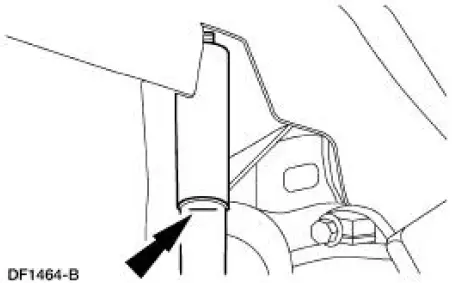
1. Mark the rear shock absorber (18125) relative to the protective sleeve with the vehicle in a static, level ground position (curb height).
2. Raise the vehicle on a hoist.
3. Support the differential housing with a jack stand.
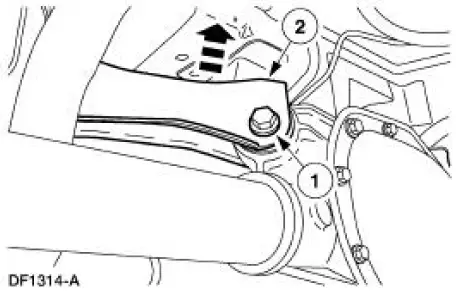
4. Disconnect the upper arm and bushing (5500) from the axle.
1. Remove and discard the nut and bolt.
2. Disconnect the arm and bushing from the axle.
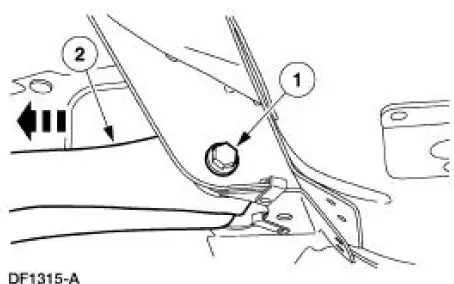
5. Remove the upper arm and bushing from the mounting bracket.
1. Remove and discard the nut and bolt.
2. Remove the arm and bushing.
 Upper Arm
...
 Installation
1. Install the upper arm and bushing to the mounting bracket.
1. Position the arm and bushing.
2. Install a new nut and bolt. Do not tighten at this time.
2. Connect the upper arm and bushing to ...
Other materials:
Pinpoint Test I: LFC 33/DTC B1933 - Passenger Air Bag Circuit Resistance
High
Normal Operation
The restraints control module (RCM) monitors the resistance of the
passenger air bag ignitor by
measuring the resistance between pins 6 and 7. If the RCM detects high
resistance between these
pins, it will store a diagnostic trouble cod ...
Pinpoint Tests
CAUTION: Do not make jumper connections except as directed.
Incorrect connections
may damage the voltage regulator test terminals, fuses, or fuse links.
CAUTION: Do not allow any metal object to come in contact with the
generator housing
and inter ...
Bearings - Inspection
NOTE: If any of the following conditions exist, install a new
bearing.
1. Inspect the bearing for a bent cage.
2. Inspect bearings for galling (metal smears on roller ends).
Galling is caused by overheating, poor lubrication or an overload
situatio ...
