
Ford Mustang (1999-2004) Service Manual: Rocker Arms - Inspection
CAUTION: Do not attempt to true surfaces by grinding. Check the rocker arm pad, side rails and seat for excessive wear, cracks, nicks or burrs. Check the rocker arm seat bolt for stripped or broken threads. Install new components as ncessary or possible damage may occur.
1. Inspect the rocker arm push rod bore for nicks, scratches, scores or scuffs. Install new components as necessary. Refer to the appropriate section in Group 303 for the procedure.
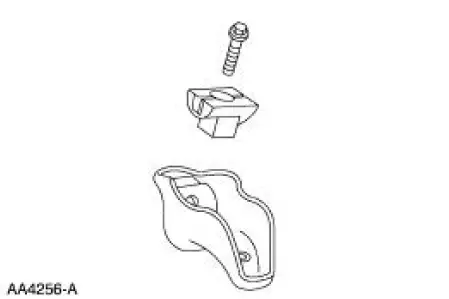
2. Inspect the pad at the valve end of the rocker arm for indications of scuffing or abnormal wear. If the pad is grooved, install a new rocker arm. Refer to the appropriate section in Group 303 for the procedure.
Push Rods - Cleaning
1. Clean the push rods (6565) in a suitable solvent. Blow out the oil passage in the push rods with compressed air.
 Sprockets
1. WARNING: To avoid the possibility of personal injury or damage
to the vehicle, do
not operate the engine with the hood open until the fan blade has been
examined for
possible cracks and separ ...
 Push Rods - Inspection
1. CAUTION: Do not attempt to straighten push rods.
Check the ends of the push rods for nicks, grooves, roughness or
excessive wear. Install new
push rods as necessary. Refer to the appropriate se ...
Other materials:
Transmission (Installation)
Material
Item
Specification
DEXRON III (ATF)
Transmission Fluid
XT-2-QDX or equivalent
DEXRON III
Pipe Sealant with Teflon
D8AZ-19554-A or equivalent
WSK-M2G350-
A2
Premium Long Life Grease
XG-1-C, K or T or equivalent
...
Camshaft Position (CMP) Sensor - 4.6L
Removal and Installation
1. Disconnect the battery ground cable. For additional information,
refer to Section.
2. Remove the bolts and position aside the power steering pump
reservoir.
3. Remove the camshaft position (CMP) sensor.
Disconnect ...
Knock
Knock, which can occur on all driving phases, has several causes including
damaged teeth or gearset.
In most cases, one of the following conditions will occur:
1. A gear tooth damaged on the drive side is a common cause of the knock.
This can usually be
cor ...
