
Ford Mustang (1999-2004) Service Manual: Removal
1. Disconnect the battery negative cable.
2. Drain the engine cooling system.
3. Remove the LH exhaust manifold. For additional information, refer to Exhaust Manifold-LH in this section.
4. Remove the lower intake manifold. For additional information, refer to Lower Intake Manifold in this section.
5. Remove the push rods. For additional information, refer to Push Rod in this section.
6. Remove the drive belt.
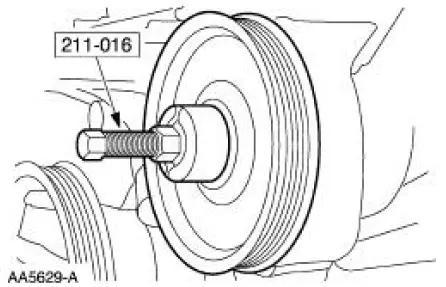
7. Using the special tool, remove the power steering pump pulley.
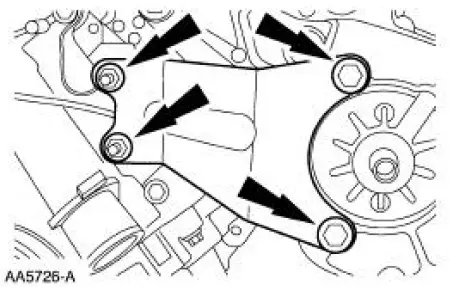
8. Remove the power steering pump bracket.
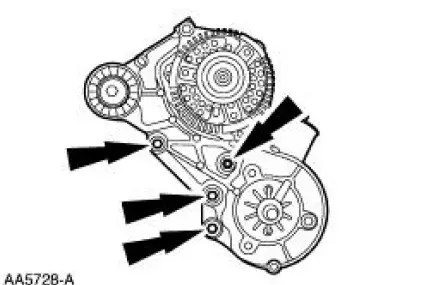
9. Remove the generator bracket.
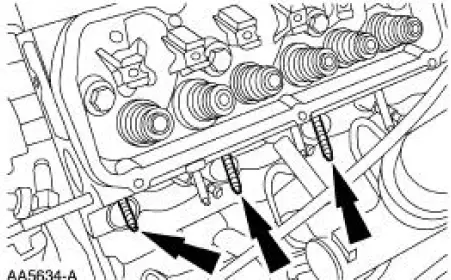
10. Remove the three exhaust manifold studs.
11. NOTE: Discard the cylinder head gasket.
NOTE: Record the location of the long bolts and the short bolts.
Remove the cylinder head. Discard the cylinder head bolts.
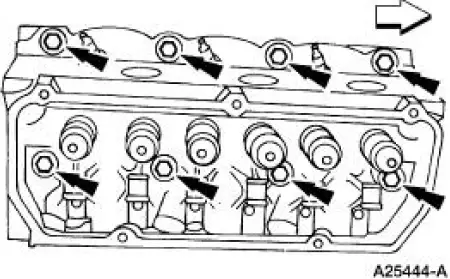
 Cylinder Head LH
Special Tool(s)
Remover, Power Steering
Pump Pulley
211-016 (T69L-10300-B)
Installer, Power Steering Pump
Pulley
211-009
Material
...
 Installation
NOTE: Do not use a fiber disc to clean the surfaces. Fibers from
the disc can get into the oil pan and
oil and clog the oil bypass valve.
1. Clean and inspect the cylinder head for flatness.
2. ...
Other materials:
Principles of Operation
NOTE: A new instrument cluster must be reconfigured. Refer to
Section.
The instrument cluster is a hybrid electronic cluster (HEC). The
instrument cluster uses both hardwired
and the standard corporate protocol (SCP) communication network to transmit
a ...
Exhaust Gas Recirculation (EGR) Valve - Mach I
Removal and Installation
1. Remove the air intake scoop. For additional information, refer to
Section.
2. Remove the exhaust gas recirculation (EGR) valve.
1. Disconnect the EGR tube upper fitting.
2. Disconnect the vacuum hose.
3. Remove the tw ...
Component Tests
Grid Wire Test
1. Using a bright lamp inside the vehicle, inspect the wire grid from
the exterior. A broken grid wire
will appear as a brown spot.
2. Run the engine at idle. Set the rear window defrost switch to ON. The
indicator light should
co ...
