
Ford Mustang (1999-2004) Service Manual: Chuckle
Chuckle that occurs on the coast driving phase is usually caused by excessive clearance between the differential gear hub and the differential case bore.
Damage to a gear tooth on the coast side can cause a noise identical to a chuckle. A very small tooth nick or ridge on the edge of a tooth can cause the noise.
Clean the gear tooth nick or ridge with a small grinding wheel. If the damaged area is larger than 3.2 mm (1/8 inch), install a new gearset.
To check the ring gear and pinion, remove as much lubricant as possible from the gears with clean solvent. Wipe the gears dry or blow them dry with compressed air. Look for scored or damaged teeth.
Also look for cracks or other damage.
If either gear is scored or damaged badly, install a new ring gear and pinion.
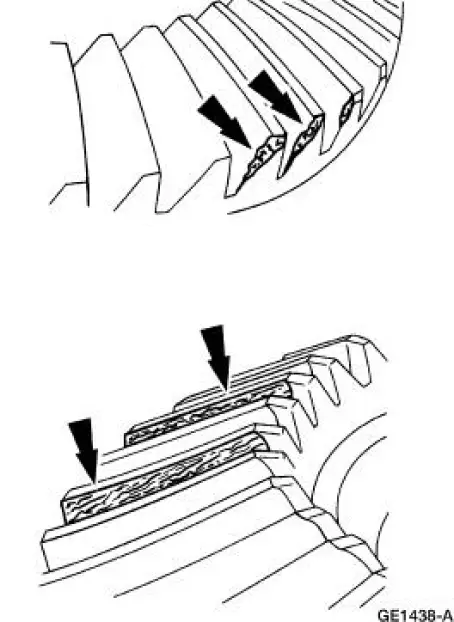
If metal has broken loose, the axle housing must be cleaned to remove particles that will cause damage. At this time, any other new parts in the axle housing must also be installed, if necessary.
 Bearing Whine
Bearing whine is a high-pitched sound similar to a whistle. It is usually
caused by worn/damaged
pinion bearings, which are operating at driveshaft speed. Bearing noise occurs
at all driving speeds. ...
 Knock
Knock
Knock, which can occur on all driving phases, has several causes including
damaged teeth or gearset.
In most cases, one of the following conditions will occur:
1. A gear tooth damaged on the drive s ...
Other materials:
Spindle
Special Tool(s)
Tie-Rod End Remover
211-001 (TOOL-3290-D) or
Equivalent
Removal
CAUTION: Suspension fasteners are critical parts because they affect
performance of vital
components and systems and their failure can result in major service expen ...
Engine Component View
Cylinder Heads and Valve Train Components
Engine Front Cover Components
Engine Components
Cylinder Block and Lower End Components
Engine (DIAGNOSIS AND TESTING)
Refer to Section for basic mechanical concerns or refer ...
Push Rod
Removal
CAUTION: Mark the components removed for correct location.
1. Remove the rocker arms (6564). For additional information, refer to
Rocker Arm in this section.
2. Remove the push rods (6565).
3. Inspect the components. For additional information, ...
