
Ford Mustang (1999-2004) Service Manual: Bearing Whine
Bearing whine is a high-pitched sound similar to a whistle. It is usually caused by worn/damaged pinion bearings, which are operating at driveshaft speed. Bearing noise occurs at all driving speeds.
This distinguishes it from gear whine which usually comes and goes as speed changes.
As noted, pinion bearings make a high-pitched, whistling noise, usually at all speeds. If however there is only one pinion bearing that is worn/damaged, the noise may vary in different driving phases. If pinion bearings are scored or damaged or there is a specific pinion bearing noise, new pinion bearings must be installed. A worn/damaged bearing will normally be obvious at disassembly. Examine the large end of the rollers for wear. If the pinion bearings original blend radius has worn to a sharp edge, a new pinion bearing must be installed.
NOTE: A low-pitched rumble normally associated with a worn/damaged wheel bearing can also be caused by tires.
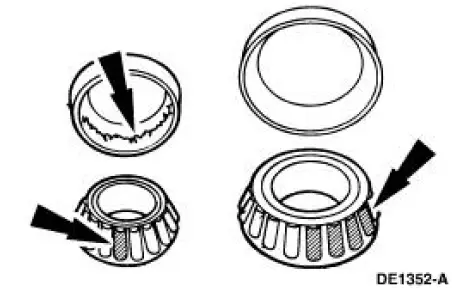
A wheel bearing noise can be mistaken for a pinion bearing noise. Check the wheel bearing for a spalled cup, and spalled/damaged rollers. Check the wheel bearing for rotating smoothness and end play. Install a new wheel bearing if any of these concerns are detected.
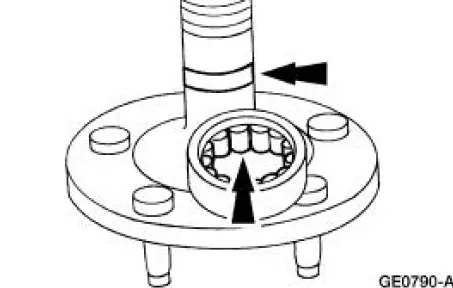
If the wheel bearing is damaged, the roller surface on the axle shaft may also be damaged. Install a new axle shaft if any damage is detected.
 Gear Howl and Whine
Howling or whining of the ring gear and pinion is due to an incorrect gear
pattern, gear damage or
incorrect bearing preload. ...
 Chuckle
Chuckle that occurs on the coast driving phase is usually caused by excessive
clearance between the
differential gear hub and the differential case bore.
Damage to a gear tooth on the coast side can ...
Other materials:
Wheel Hub or Axle Flange Face Runout
NOTE: If the axle shaft assembly is removed, check runout of the shaft
itself. The forged (unmachined)
part of the shaft is allowed to have as much as 3.0 mm (0.120 inch) runout. This
alone will not cause a
vibration condition.
1. Position the special tool ...
Frame and Mounting
Frame and Body Mounting
Torque Specifications
Frame Assembly
Underbody misalignment can affect front and rear wheel alignment, the
operation of the suspension
parts and drivetrain operation. Window glass cracks, door and window opening
concerns, and air or ...
Disassembly
Initial disassembly
1. Remove the differential housing cover (4033) and drain the lubricant into
a suitable container.
2. Wipe the lubricant from the internal working parts and inspect the parts for
wear and damage.
3. Using the special tool, measure and n ...
