
Ford Mustang (1999-2004) Service Manual: Diagnostics
Special Tool(s)
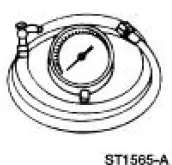 |
Transmission Fluid Pressure Gauge 307-004 (T57L-77820-A) |
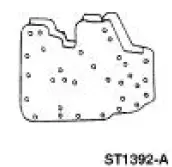 |
Air Test Plate, Transmission 307-246 (T92P-7006-A) |
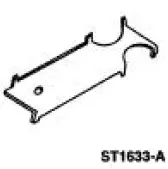 |
Alignment Gauge, TR Sensor 307-351 (T97L-70010-A) |
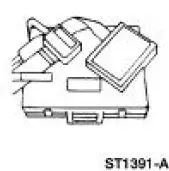 |
Breakout Box, EEC-V Control System 418-049 (T94L-50-EEC-V) or equivalent |
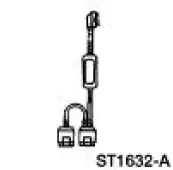 |
MLP-TR Cable 418-F107 (007-00111) or equivalent |
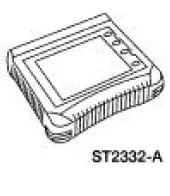 |
Worldwide Diagnostic System (WDS) 418-F224 New Generation STAR (NGS) Tester 418-F052 or equivalent scan tool |
 |
Transmission Tester 307-F016 (007-00130) or equivalent |
 |
Trans Tester TR/MLP Overlay and Manual 007-00131 or equivalent |
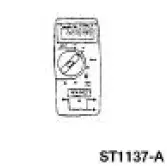 |
73 III Automotive Meter 105-R0057 or equivalent |
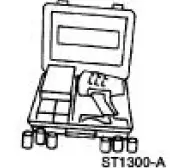 |
UV Leak Detector Kit 164-R0756 or equivalent |
Diagnosing an electronically controlled automatic transmission is simplified by using the following procedures. One of the most important things to remember is that there is a definite procedure to follow. DO NOT TAKE SHORT CUTS OR ASSUME THAT CRITICAL CHECKS OR ADJUSTMENTS HAVE ALREADY BEEN MADE. Follow the procedures as written to avoid missing critical components or steps. By following the diagnostic sequence, the technician will be able to diagnose and repair the concern the first time.
On-Board Diagnostics With Diagnostic Tool
NOTE: For detailed instruction and other diagnostic methods using the scan tool, refer to the scan tool tester manual and the Powertrain Control/Emissions Diagnosis (PC/ED) manual. These quick tests should be used to diagnose the powertrain control module (PCM) and should be carried out in order.
- Quick Test 1.0 - Visual Inspection
- Quick Test 2.0 - Set Up
- Quick Test 3.0 - Key On, Engine Off (KOEO)
- Quick Test 4.0 - Continuous Memory
- Quick Test 5.0 - Key On, Engine Running (KOER)
- Special Test Mode
- Wiggle Test
- Output Test Mode
- PCM Reset Mode
- Clearing DTCs
- OBD II Drive Cycle
- Other Scan Tool Features
For further information on other diagnostic testing features using the scan tool, refer to the Powertrain Control/Emissions Diagnosis (PC/ED) manual. Other diagnostic methods include the following:
- Parameter Identification (PID) Access Mode
- Freeze Frame Data Access Mode
- Oxygen Sensor Monitor Mode
 Torque Converter Diagnosis
Prior to the installation of a new or remanufactured torque
converter, all diagnostic procedures must be
followed. This is to prevent the unnecessary installation of torque
converters. Only af ...
 Output State Control (OSC) Mode
Output State Control (OSC) allows the technician to take control of
certain parameters to function the
transmission. For example, OSC allows the technician to shift the
transmission only when ...
Other materials:
Pinpoint Tests
PINPOINT TEST A: THE ENGINE DOES NOT CRANK AND THE
RELAY DOES CLICK
Test Step
Result / Action to Take
A1 CHECK THE VOLTAGE TO THE STARTER RELAY
YesGO to A2 .
No
REPAIR circuit 1050 (LG/VT) for an open. TEST the
system for normal operation. ...
Installation
1. Install the upper arm and bushing to the mounting bracket.
1. Position the arm and bushing.
2. Install a new nut and bolt. Do not tighten at this time.
2. Connect the upper arm and bushing to the axle.
1. Position the arm and bushing.
2. Install a ...
Removal
WARNING: Do not smoke, carry lighted tobacco or an open flame of any
type when
working on or near any fuel-related components. Highly flammable mixtures are
always present
and may be ignited, possibly resulting in personal injury.
WARNING: Fuel supply lines ...
