
Ford Mustang (1999-2004) Service Manual: Retractor - Rear Seat Safety Belt, Coupe
Special Tool(s)
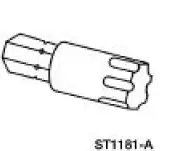 |
Torx Bit, Safety Belt Bolt 501-010 (T77L-2100-A) |
Removal
1. Remove the quarter trim panel (31012) and the angel wing trim. For additional information, refer to Section.
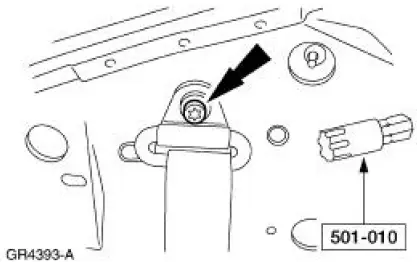
2. Using the special tool, remove the D-ring bolt.
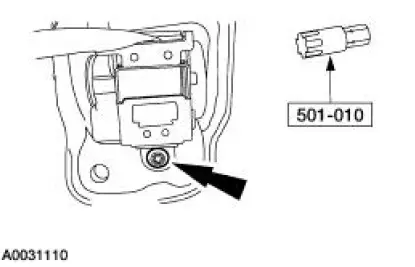
3. Using the special tool, remove the bolt and the safety belt retractor (611B68).
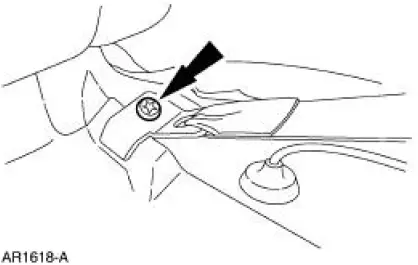
4. Remove the bolt.
Installation
NOTE: Make sure the safety belt is not twisted when inserting it in the quarter trim panel.
1. Install the bolt.
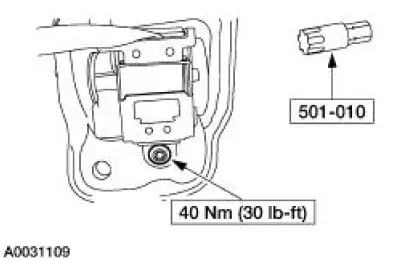
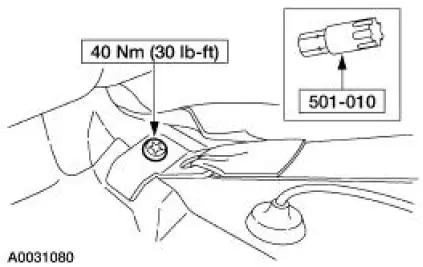
2. Using the special tool, install the safety belt retractor and the bolt.
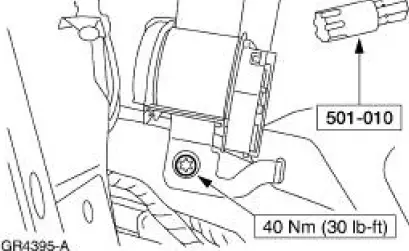
3. Using the special tool, install the D-ring bolt.
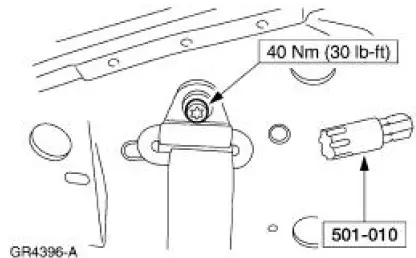
4. Install the quarter trim panel (31012) and the angel wing trim. For additional information, refer to Section.
5. Make sure the shoulder belt passes through the belt holder on the top of the seatback.
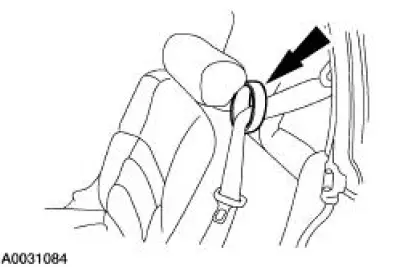
6. Check the active restraint system for correct operation.
 Retractor - Front Seat Safety Belt, Convertible
Special Tool(s)
Torx Bit, Safety Belt Bolt
501-010 (T77L-2100-A)
Removal
1. Remove the quarter trim panel (31012). For additional information, refer
to Section.
2. Remove the nut and ...
 Retractor - Rear Seat Safety Belt, Convertible
Special Tool(s)
Torx Bit, Safety Belt Bolt
501-010 (T77L-2100-A)
Removal
1. Remove the rear seat cushion.
2. Remove the luggage compartment front lining board (45444).
3. Release the ...
Other materials:
Front Bumper Cover
Removal and Installation
NOTE: Mustang shown, GT and Cobra similar.
1. Remove the pin-type retainers and the radiator upper sight shield.
2. Remove the two pin-type retainers (one each side).
3. Remove the four front bumper cover nuts (two each side).
4. ...
Gear (Removal and Installation)
Special Tool(s)
Teflon Seal Replacer Set
211-D027 (D90P-3517-A) or
Equivalent
Tie Rod End Remover
211-001 (TOOL-3290-D)
Removal
1. Turn the steering wheel as necessary to position the wheels in the
straight-ahead position. Do
not loc ...
Steering Column (Description and Operation)
NOTE: All fasteners are important because they can affect the
performance of vital parts and systems.
Incorrect installation of the fasteners can result in major repair expenses.
They must be installed new
with fasteners of the same part number ...
