
Ford Mustang (1999-2004) Service Manual: System Bleeding
1. If required, remove the hydraulic system from the vehicle. Refer to Hydraulic System, Lift Cylinder and Motor in this section.
2. Remove the fill plug at the end of the hydraulic pump.
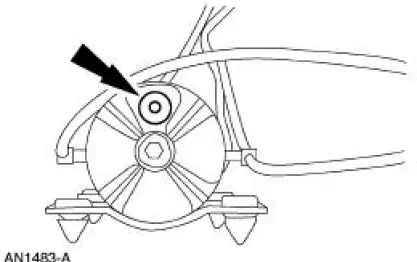
3. Fill the pump with Mercon Multi-Purpose Automatic Transmission Fluid XT-2-QDX or equivalent to the bottom of the fill hole and install the fill plug.
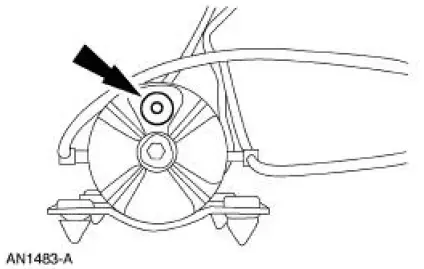
4. NOTE: Some noise squeal may be noticed due to the air in the system.
Connect a 12-volt power source to the motor connector and operate the motor until the cylinders are fully extended. Reverse the 12-volt connection to fully retract the cylinders. Repeat this procedure three times.
5. Remove the fill plug and check the fluid level. Fill the pump with MERCON Multi-Purpose Automatic Transmission Fluid XT-2-QDX or equivalent to the bottom of the fill hole.
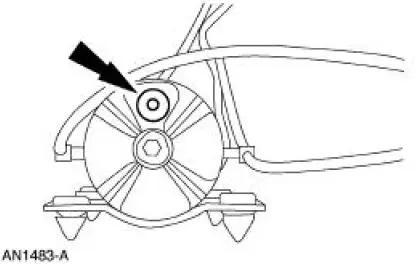
6. Install a fill plug.
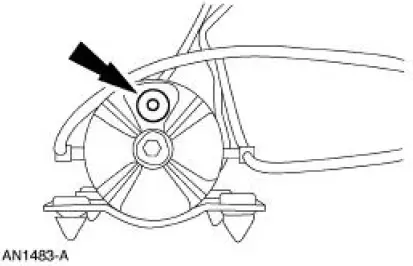
7. Install the hydraulic system in the vehicle. Refer to Hydraulic System, Lift Cylinder and Motor in this section.
 Convertible Top (Diagnosis and Testing)
Refer to Wiring Diagrams Cell 103 , for schematic and connector
information.
Special Tool(s)
73 III Automotive Meter
105-R0057 or equivalent
Principles of Operation
The converti ...

Other materials:
Audible warnings and indicators
Key In Ignition Warning Chime
Sounds when the key is left in the ignition in the off or accessory
position and the driver’s door is opened.
Keyless Warning Alert (If Equipped)
Sounds when the keyless vehicle is in RUN and the driver’s door is
opened.
Hea ...
Assembly
1. CAUTION: Before beginning assembly, carry out and inspect the
following:
When building up subassemblies and assembling the transmission, ALWAYS use new
gaskets and seals.
All fasteners must be tightened to the torque specification indicated. In
addition ...
Module - Daytime Running Lamps (DRL)
Removal
1. CAUTION: Electronic modules are sensitive to static electrical
charges. If exposed
to these charges, damage can result.
Disconnect the battery ground cable.
2. Remove the daytime running lamps (DRL) module and bracket assembly
(15A270).
...
