
Ford Mustang (1999-2004) Service Manual: Transmission Fluid Cooler Tubes
Removal
1. Disconnect the battery cables.
2. Raise and support the vehicle. For additional information, refer to Section.
3. Remove the nuts.
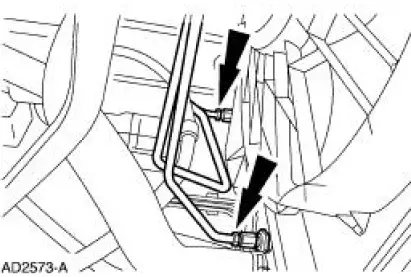
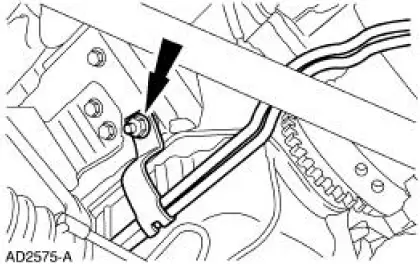
4. Remove the fluid cooler tube bracket at the engine.
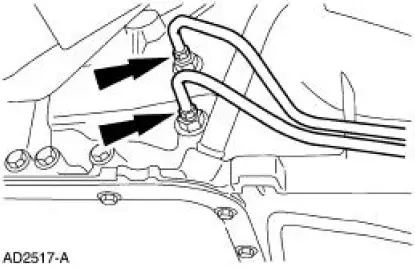
5. NOTE: Use a backup wrench to hold the case fitting secure.
Remove the fluid cooler tubes at the transmission.
Installation
1. NOTE: Use a backup wrench to hold the case fitting secure.
Install the fluid cooler tubes at the transmission.
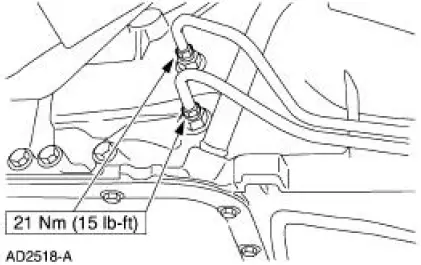
2. Install the fluid cooler tube bracket at the engine.
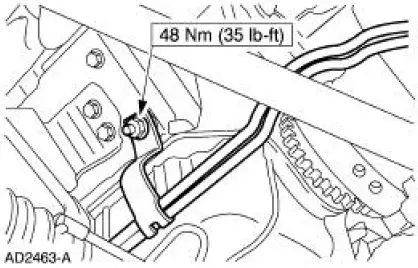
3. Install the nuts.
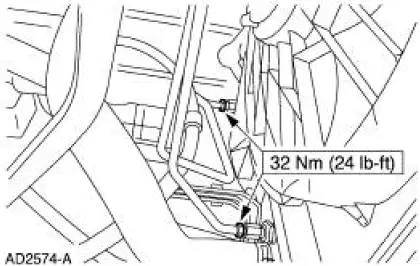
4. Lower the vehicle.
5. Connect the battery cables.
6. Fill the transmission with fluid and verify proper operation.
- Use Motorcraft MERCON V Automatic Transmission Fluid XT-5-QM or equivalent meeting MERCON V specification.
 Transmission Cooling
Inspection and Verification
WARNING: Never remove the radiator cap under any conditions while the engine
is
operating. Failure to follow these instructions could result in personal injury
and/or dam ...
 Automatic Transaxle/Transmission External Controls
Torque Specifications
...
Other materials:
Engine (Diagnosis and Testing)
Special Tool(s)
Commercially Available
Leakdown Tester
Quick Disconnect Compression
Tester
134-R0212 or equivalent
Dial Indicator Gauge Adapter
303-007 (TOOL-6565-AB) or
equivalent
Dial Indicator Gauge with
Holdin ...
Removal
1. Raise and support the vehicle.
2. Remove the wheel and tire assembly.
3. WARNING: Brake fluid contains polyglycol ethers and polyglycols.
Avoid contact
with eyes. Wash hands thoroughly after handling. If brake fluid contacts
eyes, flush eyes ...
Switch - Window Regulator Control
Removal
1. CAUTION: Use a shop towel or similar material between the
tool and the door trim
panel or damage to the door trim panel may occur.
Position the window regulator switch plate aside.
1. Pull at the service notch.
2. Lift to release ...
