
Ford Mustang (1999-2004) Service Manual: Cleaning
1. Fabricate a cleaning tool from a 1/8 inch diameter brazing rod.
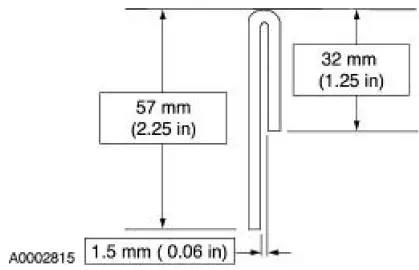
2. Cut an abrasive pad from maroon colored 3M Scotch Brite with the dimensions corresponding to the coupling size.
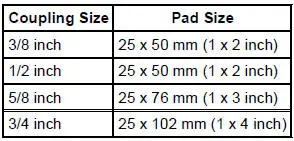
3. Assemble the pad to the tool.
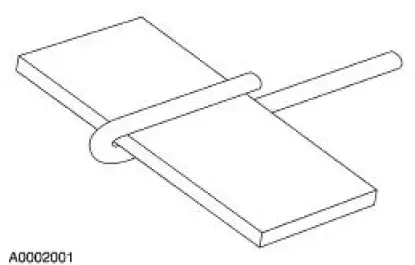
4. Coat the abrasive pad with PAG Refrigerant Compressor Oil (R-134a Systems) or equivalent.
5. Roll the pad on the tool and install it in a variable speed drill motor.
6. CAUTION: Maintain low speed drill rotation when inserting or removing the cleaning tool to prevent axial scratches which may cause future leaks.
Polish for one minute at moderate speed (less than 1,500 rpm) or until the surface is clean and free of scratches or foreign material.
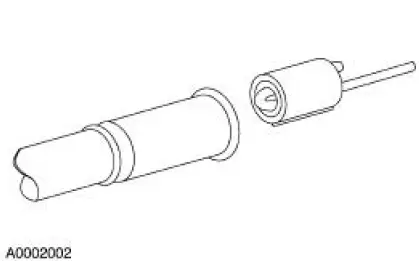
7. Clean the fitting with a lint-free cloth.
8. Inspect the surface for grooves or scratches. If grooves and scratches are still present, install a new component.
9. Clean the O-ring seal grooves with a 300 mm (12 inch) length of natural fiber string.
- Loop the string around the grooves and pull the string back and forth.
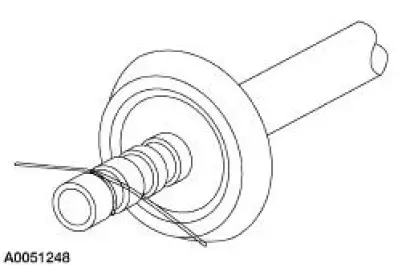
10. Remove any foreign material from the grooves with a lint-free cloth.
 Disconnect
1. Remove the A/C tube lock coupling clip (19E746), if equipped.
2. Fit the special tool to the spring lock coupling.
3. Push the tool into the cage opening to release the female fitting from the ...
 Connect
1. Install the A/C tube lock coupling spring.
2. Lubricate the inside of the coupling with PAG Refrigerant Compressor Oil
(R-134a Systems) or
equivalent.
3. CAUTION: Use only the new O-ring seals ...
Other materials:
Inspection and Verification
NOTE: Upon installation of a new GEM, the module must be
reconfigured. For additional information,
refer to Section.
1. The warning lamps are a GEM controlled system; refer to Section.
2. Verify the customer concern by operating the system in questio ...
Installation
1. Install the upper arm and bushing to the mounting bracket.
1. Position the arm and bushing.
2. Install a new nut and bolt. Do not tighten at this time.
2. Connect the upper arm and bushing to the axle.
1. Position the arm and bushing.
2. Install a ...
Evaporative Emissions (Diagnosis and Testing)
Special Tool(s)
Evaporative Emission System
Leak Tester
310-F007 (134-00056) or
equivalent
Worldwide Diagnostic System
(WDS)
418-F224,
New Generation STAR (NGS)
Tester
418-F052, or equivalent scan
tool
Evaporative Em ...
