
Ford Mustang (1999-2004) Service Manual: Fuel System (Description and Operation)
Component Location
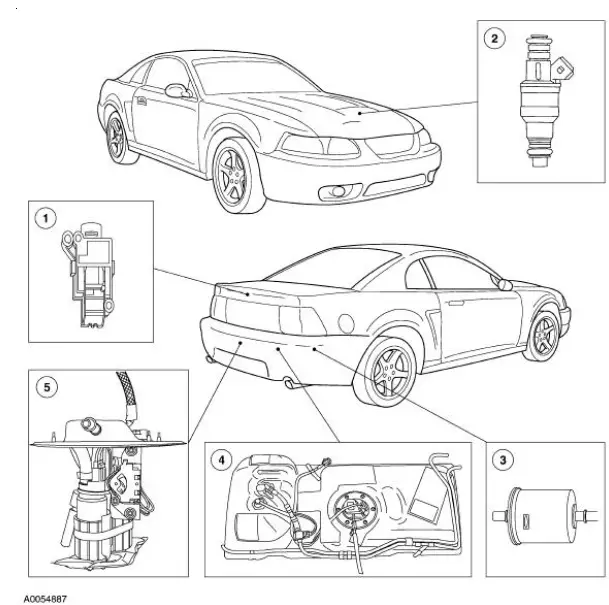
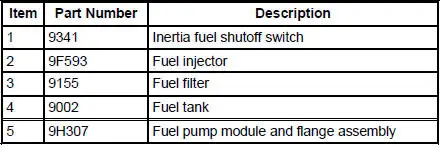
WARNING: Do not smoke or carry lighted tobacco or open flame of any type when working on or near any fuel-related components. Highly flammable mixtures are always present and may be ignited, resulting in possible personal injury.
The vehicle:
- uses a returnless fuel system.
- is equipped with a multiport fuel injection (MFI) system.
- uses separately controlled fuel injectors (9F593) for each cylinder. The fuel injectors are mounted to the intake manifold.
- fuel injectors are supplied with pressurized fuel from the fuel pump (9350) through the fuel injection supply manifold (9D280).
- fuel injection supply manifold is controlled by the electronic fuel delivery module which is enabled by the powertrain control module (PCM) (12A650).
Fuel System
Refer to the Powertrain Control/Emissions Diagnosis (PC/ED) manual.
 Fuel System - General Information
General Specifications
...
 Pressure Relief
Special Tool(s)
Fuel Pressure Gauge
310-012 (T80L-9974-B)
WARNING: Do not smoke or carry lighted tobacco or open flame of any
type when
working on or near any fuel-related components. ...
Other materials:
Component Test
Carry out the appropriate Functional Test(s) as determined in Inspection and
Verification.
Functional Test I (Buckle and Tongue)
The safety belt buckle and tongue assembly must operate freely during the
latching and unlatching
function. Fasten the safety bel ...
Preliminary Inspection
The following items must be checked prior to beginning the diagnostic
procedures:
Know and Understand the Concern
In order to correctly diagnose a concern, first understand the
customer complaint or condition.
Customer contact may be required in ord ...
Driveline System
Special Tool(s)
Clamp Plate
205-320 (T92L-4851-C)
Clutch Housing Alignment
Adapter
308-021 (T75L-4201-A)
Companion Flange Holding
Tool
205-126 (T78P-4851-A)
Companion Flange Runout
Gauge
205-319 (T92 ...
