
Ford Mustang (1999-2004) Service Manual: Installation
1. Install the lower intake manifold gaskets.
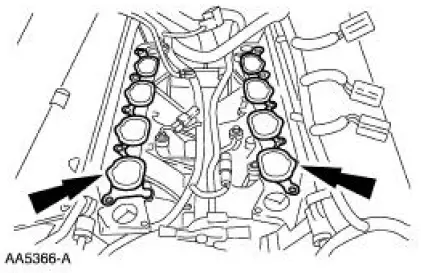
2. Connect the fuel charging wiring harness to the rear of the lower intake manifold and install the manifold.
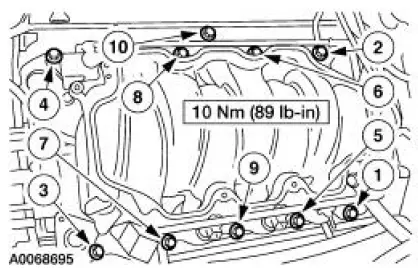
3. Install the intake manifold fasteners and tighten in the sequence shown.
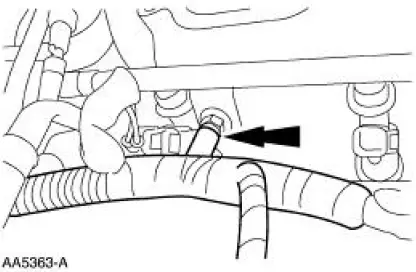
4. Position the fuel charging wiring harness and connect it to the fuel injection supply manifold in three places.
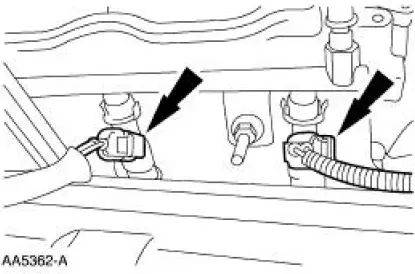
5. Connect the eight fuel injector electrical connectors.
6. Connect the electrical connector and the vacuum line to the fuel pressure sensor.
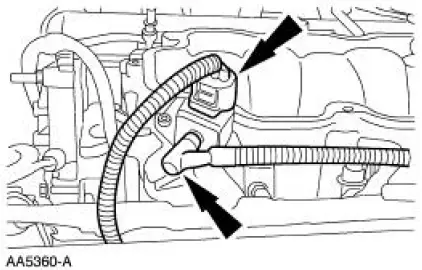
7. Install the generator. For additional information, refer to Section .
8. Install the coolant bypass tube. For additional information, refer to Section.
9. Connect the fuel line. For additional information, refer to Section.
10. Install the upper intake manifold. For additional information, refer to Intake Manifold-Upper in this section.
 Removal
1. Remove the upper intake manifold. For additional information, refer to
Intake Manifold-Upper
in this section.
2. Disconnect the fuel line. For additional information, refer to Section.
3. Remove ...
 Valve Cover RH
Material
Item
Specification
Metal Surface Cleaner
F4AZ-19A536-RA or equivalent
WSE-M5B392-
A
Silicone Gasket and Sealant
F7AZ-19554-EA or equivalent
WSE-M4G323-
A4
...
Other materials:
Evaporator Core Housing
Disassembly
1. Remove the evaporator core housing. For additional information, refer to
Evaporator Core
Housing in this section.
2. Remove the foam weather seal.
3. Remove the screws and remove the heater core.
4. Remove the screws and remove the A/C rec ...
Brake System (Diagnosis and Testing)
Refer to Wiring Diagrams Cell 60, Instrument Cluster for schematic and
connector information.
Refer to Wiring Diagrams Cell 97, Daytime Running Lamps for schematic and
connector information.
Special Tool(s)
73 Digital Multimeter
105-R0051 or Equiva ...
Removal
1. Remove the upper intake manifold. For additional information, refer to
Intake Manifold-Upper
in this section.
2. Disconnect the fuel line. For additional information, refer to Section.
3. Remove the coolant by-pass tube. For additional information, refer ...
