
Ford Mustang (1999-2004) Service Manual: Range Selection
The transmission has six range positions: P, R, N, (D), 2 and 1.
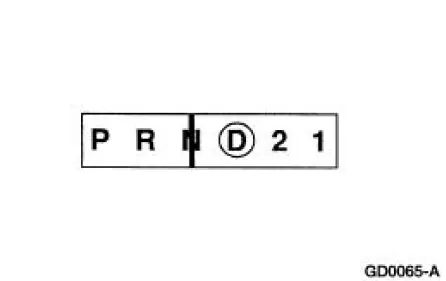
Park
In the PARK position:
- there is no powerflow through the transmission.
- the parking pawl locks the output shaft to the case.
- the engine can be started.
- the ignition key can be removed.
Reverse
In the REVERSE position:
- the vehicle can be operated in a rearward direction, at a reduced gear ratio.
- engine braking will occur.
Neutral
In the NEUTRAL position:
- there is no powerflow through the transmission.
- the output shaft is not held and is free to turn.
- the engine can be started.
Overdrive
Overdrive is the normal position for most forward driving.
The OVERDRIVE position provides:
- Automatic shifts.
- Apply and release of the torque converter clutch.
- Maximum fuel economy during normal operation.
Second Position
This position provides:
- Second gear start and hold.
- The torque converter clutch can apply and release.
- Improved traction and engine braking on slippery roads.
- Engine braking for descending steep grades.
First Position
If this position is selected at normal road speeds, the transmission will shift into second gear, then into first when the vehicle reaches a speed below approximately 45 km/h (28 mph).
This position provides:
- First gear operation only.
- Engine braking for descending steep grades.
 Identification Tags
All vehicles are equipped with a Vehicle Certification Label, located
on the driver side door lock post.
For correct transmission identification, refer to the code in the space
marked TR.
...
 Shift Patterns
Upshifts
Transmission upshifting is controlled by the powertrain control
module (PCM). The PCM receives
inputs from various engine or vehicle sensors and driver demands to
control shift sche ...
Other materials:
Camber Adjustment - Rear
1. Loosen the nut.
2. Rotate the bolt and the cam to the correct camber setting.
3. Tighten the nut while holding the bolt and the cam stationary.
4. Recheck the wheel alignment. Follow the manufacturer's instructions.
Adjust as necessary. ...
Water Bypass Hose - 3.8L
Removal and Installation
1. Drain the engine coolant. For additional information, refer to Cooling
System Draining, Filling
and Bleeding in this section.
2. Remove the bypass hose.
3. To install, reverse the removal procedure.
4. Fill and bleed the co ...
Installation
1. CAUTION: Do not use metal scrapers, wire brushes, power abrasive
discs or other
abrasive means to clean the sealing surfaces. These tools cause scratches and
gouges
which make leak paths. Use a plastic scraping tool to remove all traces of old
sealant.
...
