
Ford Mustang (1999-2004) Service Manual: Supply Manifold
Removal and Installation
WARNING: Do not smoke or carry lighted tobacco or open flame of any type when working on or near any fuel related components. Highly flammable mixtures are always present and may ignite. Failure to follow these instructions may result in personal injury.
WARNING: Fuel in the fuel system remains under high pressure even when the engine is not running. Before working on or disconnecting any of the fuel lines or fuel system components, the fuel system pressure must be relieved. Failure to follow these instructions may result in personal injury.
1. Disconnect the battery ground cable.
2. Remove the upper intake manifold. For additional information, refer to Section.
3. Relieve the fuel pressure. For additional information, refer to Section.
4. Disconnect the fuel line. For additional information, refer to Section.
5. Separate the wiring harness from the supply manifold.
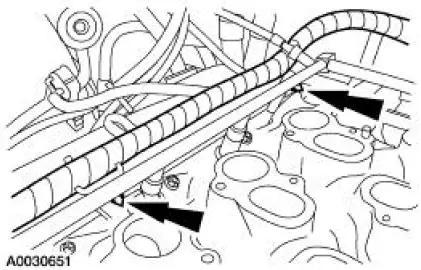
6. NOTE: Right side shown, left side similar.
Disconnect the six fuel injector electrical connectors.
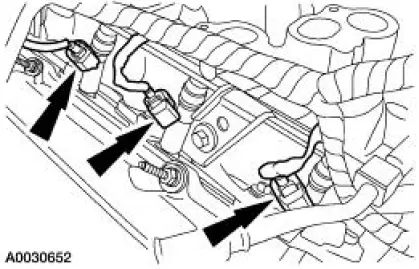
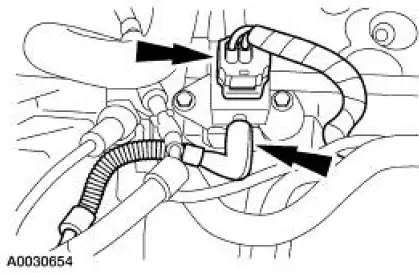
7. Disconnect the fuel pressure sensor.
- Disconnect the connector.
- Disconnect the vacuum hose.
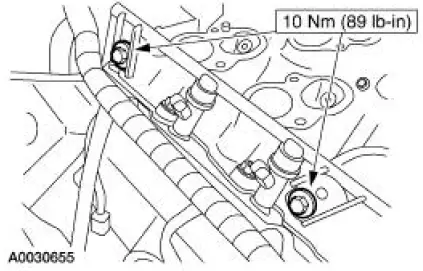
8. NOTE: The right side is shown. The left side is similar.
Remove the four supply manifold bolts and remove the fuel supply manifold with the injectors.
9. NOTE: When the battery (10655) is disconnect and reconnected, some abnormal drive symptoms may occur while the vehicle relearns its adaptive strategy. The vehicle may need to be driven 16 km (10 mi) or more to relearn the strategy.
To install, reverse the removal procedure.
 Fuel Charging Wiring Harness
Removal and Installation
WARNING: Do not smoke or carry lighted tobacco or open flame of any
type when
working on or near any fuel related components. Highly flammable mixtures are
always present
an ...
 Fuel Charging and Controls - 4.6L (2V)
General Specifications
Torque Specifications
...
Other materials:
Powertrain/Drivetrain Mount Neutralizing
WARNING: The electrical power to the air suspension system must be shut
off prior to
hoisting, jacking or towing an air suspension vehicle. This can be accomplished
by turning off
the air suspension switch. Failure to do so can result in unexpected inflation ...
Underbody Misalignment Check
Underbody Dimensions
1. Underbody dimensions tolerances are +- 3.175 mm (0.125 in). Reference
dimensions are not
controlled dimensions. Reference points are +- 4.76 mm (0.1875 in). All underbody
dimensions
are detailed to the centerline of existin ...
Steering Column Shaft
Removal and Installation
1. CAUTION: Do not allow the steering column shaft to rotate while
intermediate shaft
is disconnected or damage to the clockspring can result. If there is evidence
that the
steering column shaft has rotated the clockspring must be re ...
