
Ford Mustang (1999-2004) Service Manual: Wheel Hub or Axle Flange Bolt Circle Runout
NOTE: The brake discs must be removed to carry out all runout measurements.
1. Position the special tool perpendicular to the wheel hub or axle flange bolt, as close to the hub or flange face as possible. Zero the indicator to allow the pointer to deflect either way.
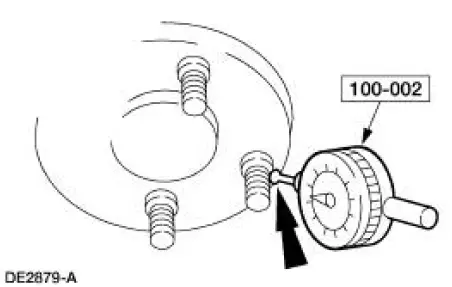
2. Rotate the hub or flange until the next bolt is contacted. Record the measurement and continue until each bolt is checked. The difference between the maximum and minimum contact readings will be the total wheel hub or axle flange bolt pattern runout. The runout must not exceed 0.38 mm (0.015 inch).
Pilot Runout
1. Position the special tools as close to the hub or axle flange face as possible. Zero the indicator to allow the pointer to deflect either way.
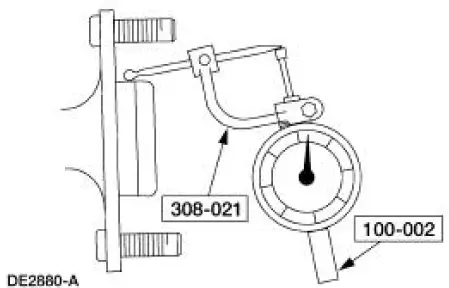
2. Rotate the hub or flange one full turn and note the maximum and minimum readings. The difference between the maximum and minimum readings will be the total pilot runout. Pilot runout must not exceed 0.15 mm (0.006 inch).
 Driveline Angle
Item
Description
1
Bottom of the frame
2
Engine crankshaft centerline
3
Engine angle
4
Driveshaft and coupling shaft centerline
5
Driveshaft an ...
 Wheel Hub or Axle Flange Face Runout
NOTE: If the axle shaft assembly is removed, check runout of the shaft
itself. The forged (unmachined)
part of the shaft is allowed to have as much as 3.0 mm (0.120 inch) runout. This
alone will not ...
Other materials:
Assembly
1. NOTE: Universal joint service kits are to be installed as complete
assemblies only. Do not mix
components from other U-joint kits.
Install the bearing cup.
1. Start a new bearing cup into the driveshaft yoke.
Check the needle bearings for correct po ...
General information
Note: Occasional brake noise is normal. If a metal-to-metal,
continuous
grinding or continuous squeal sound is present, the brake linings may be
worn out. Have them inspected by an authorized dealer. If your vehicle
has continuous vibration or shudder in the ...
Reservoir
Removal
1. Remove the LF wheel and tire. Refer to Section.
2. Position the front portion of the LF inner splash shield aside.
3. WARNING: Windshield washer solution contains methanol, which is
poisonous.
Observe all cautions and warnings indicate ...
