
Ford Mustang (1999-2004) Service Manual: Evaporator Core Orifice
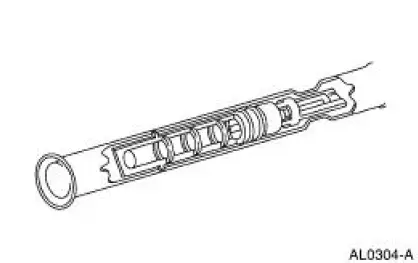
NOTE: The evaporator core orifice is an integral part of the condenser to evaporator line and should be installed as an assembly with the line.
NOTE: A new evaporator core orifice should be installed whenever a new A/C compressor is installed.
The evaporator core orifice has the following characteristics:
- It is located in the A/C condenser to evaporator line.
- It has filter screens located on the inlet and outlet ends of the tube body.
- The inlet filter screen acts as a strainer for the liquid refrigerant flowing through the evaporator core orifice.
- O-ring seals on the evaporator core orifice prevent the high-pressure liquid refrigerant from bypassing the evaporator core orifice.
- Adjustment or repair cannot be made to the evaporator core orifice assembly. A new evaporator core orifice must be installed as a unit.
 Refrigerant Lines
The condenser to evaporator tube (19835) contains the high pressure liquid
refrigerant upstream of the
evaporator core orifice.
The A/C manifold and tube (19D734) is attached to the A/C compressor, ...
 Suction Accumulator
NOTE: Installation of a new suction accumulator is not required when
repairing the air conditioning
system except when there is physical evidence of contamination from a failed A/C
compres ...
Other materials:
Output Shaft and Direct Clutch Cylinder
Special Tool(s)
Compressor, Clutch Spring
307-015 (T65L-77515-A)
Protector, Piston Seal
307-080 (T80L-77234-A)
Protector, Transmission Direct
Clutch Outer Fluid Seal
307-422
Material
Item
Specification
...
Push Rod
Removal
CAUTION: Mark the components removed for correct location.
1. Remove the rocker arms (6564). For additional information, refer to
Rocker Arm in this section.
2. Remove the push rods (6565).
3. Inspect the components. For additional information, ...
Fuel Charging Wiring Harness
Removal and Installation
WARNING: Do not smoke or carry lighted tobacco or open flame of any
type when
working on or near any fuel related components. Highly flammable mixtures are
always present
and may ignite. Failure to follow these instructions may resul ...
