
Ford Mustang (1999-2004) Service Manual: Installation
All vehicles
1. NOTE: Inspect the insulators for wear or damage. Install new insulators if necessary.
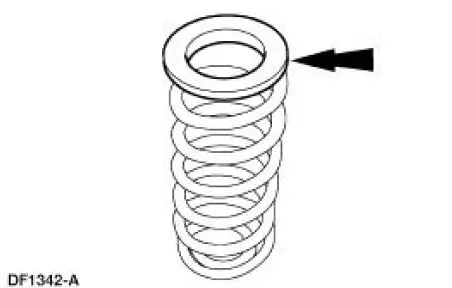
Install the upper insulator on the spring.
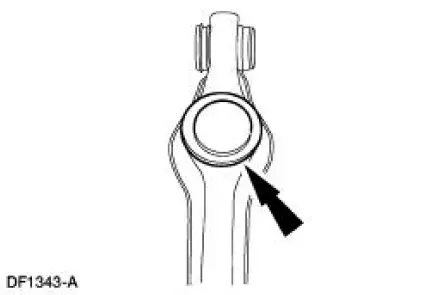
2. Install the lower insulator on the lower arm.
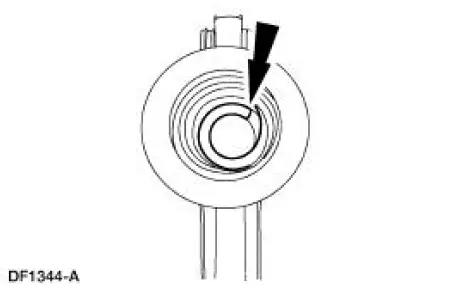
3. Install the rear spring. Make sure the pigtail on the lower arm is at the rear of the vehicle and pointing toward the left side of the vehicle.
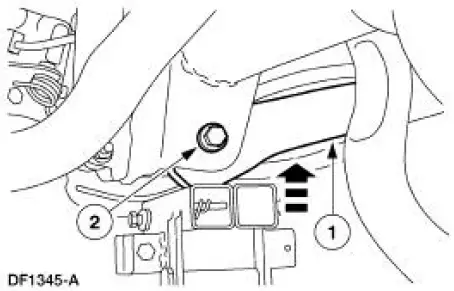
4. Install the pivot bolt.
1. Carefully raise the lower arm into position with the special tool 014-00942.
2. Install a new pivot bolt and nut. Do not tighten at this time.
5. Remove the special tool 014-00942.
6. Raise the suspension until the shock absorber is compressed to the alignment mark (curb height).
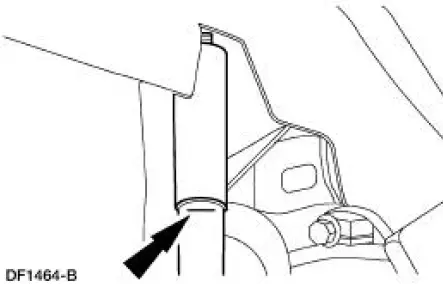
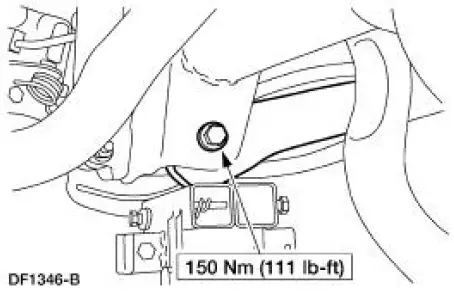
7. Tighten the lower arm-to-axle pivot bolt.
8. Lower the rear suspension and remove the jack stand.
Vehicles equipped with a 4.6L 2V engine
9. Install the stabilizer bar. For additional information, refer to Stabilizer Bar in this section.
All vehicles
10. Install the parking brake cable bracket and a new bolt.
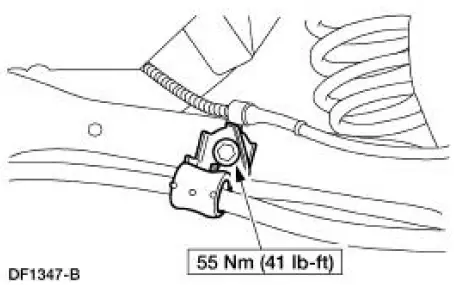
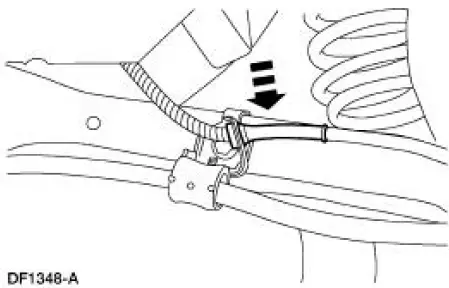
11. Connect the anti-lock sensor wire.
12. Lower the vehicle.
 Removal
CAUTION: Suspension fasteners are critical parts because they affect
performance of vital
components and systems and their failure can result in major service expense. A
new part with
the same part ...
 Spring - Cobra
Special Tool(s)
Rotunda Powertrain Lift
014-00765 or Equivalent
...
Other materials:
Transmission (Removal)
1. Remove the gearshift lever knob.
2. Remove the console panel gearshift plate. Disconnect the cigar lighter
electrical connector, then
lift the gearshift lever boot over the gearshift lever.
3. Remove the bolts and the upper gearshift lever.
4. Remove ...
Disassembly
1. Remove the differential assembly from the differential housing. For
additional information, refer
to Differential Case in this section.
2. Remove the bolts.
3. CAUTION: Do not damage the threads in the bolt holes.
Insert a punch in the bolt holes and d ...
Axle
Special Tool(s)
2-Jaw Puller
205-D072 (D97L-4221-A) or
equivalent
Adapter for 205-S127
205-105 (T76P-4020-A3)
Bearing Preload Tool
205-395 (T93P-4220-A)
Plate, Bearing/Oil Seal
205-090 (T75L-1165-B)
Gauge, ...
