
Ford Mustang (1999-2004) Service Manual: Electronic Engine Controls
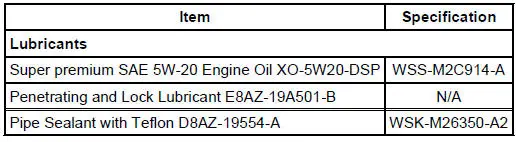
General Specifications
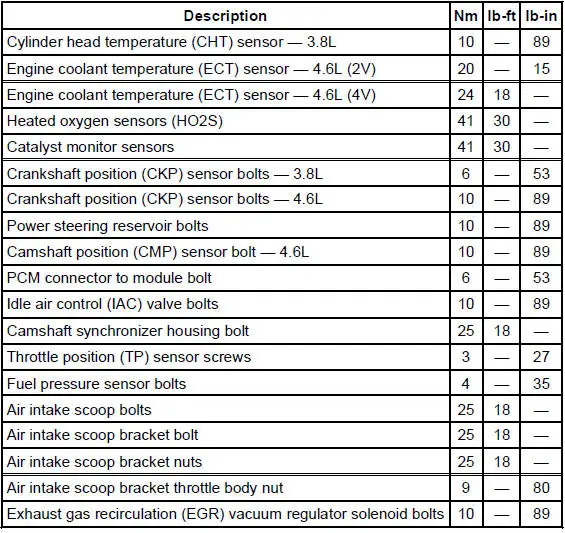
Torque Specifications
- Electronic Engine Controls (Description and Operation)
- Electronic Engine Controls - Cobra
- Temperature and Manifold Absolute Pressure (T-MAP) Sensor - Cobra
- Camshaft Position (CMP) Sensor - 3.8L
- Camshaft Position (CMP) Sensor - 4.6L
- Intake Manifold Runner Control (IMRC) Actuator - 3.8L
- Crankshaft Position (CKP) Sensor - 3.8L
- Crankshaft Position (CKP) Sensor - 4.6L
- Powertrain Control Module (PCM)
- Throttle Position (TP) Sensor
- Idle Air Control (IAC) Valve - 3.8L
- Idle Air Control (IAC) Valve - 4.6L (2V)
- Idle Air Control (IAC) Valve - Cobra
- Idle Air Control (IAC) Valve - Mach I
- Cylinder Head Temperature (CHT) Sensor - 3.8L
- Engine Coolant Temperature (ECT) Sensor - 4.6L (2V)
- Engine Coolant Temperature (ECT) Sensor - Cobra
- Engine Coolant Temperature (ECT) Sensor - Mach I
- Mass Air Flow (MAF) Sensor - 3.8L
- Mass Air Flow (MAF) Sensor - 4.6L (2V)
- Mass Air Flow (MAF) Sensor - Cobra
- Mass Air Flow (MAF) Sensor - Mach I
- Heated Oxygen Sensor (HO2S)
- Catalyst Monitor Sensor
- Clutch Pedal Position (CPP) Switch
- Fuel Pressure Sensor
- Supercharger Bypass Vacuum Solenoid - Actuator
 Evaporative Emission Test Port
Removal and Installation
1. Disconnect the pin-type retainer.
2. Raise and support the vehicle. For additional information, refer to
Section.
3. Remove the RH front wheel. For additional informa ...
 Electronic Engine Controls (Description and Operation)
The electronic engine controls consist of the following:
powertrain control module (PCM)
throttle position (TP) sensor
idle air control (IAC) valve
engine coolant temperature (ECT) sens ...
Other materials:
Bushing - Stabilizer Bar
Removal
CAUTION: Suspension fasteners are critical parts because they affect
performance of vital
components and systems and their failure can result in major service expense. A
new part with
the same part number or an equivalent part must be installed, if i ...
Cleaning
1. Fabricate a cleaning tool from a 1/8 inch diameter brazing rod.
2. Cut an abrasive pad from maroon colored 3M Scotch Brite with the
dimensions corresponding
to the coupling size.
3. Assemble the pad to the tool.
4. Coat the abrasive pad with PAG Refri ...
Cable - Antenna Lead In
Removal
1. Remove the audio unit. Refer to Section.
2. Lower the glove compartment by releasing the stops from the
instrument panel.
3. Disconnect the antenna in-line connector.
4. Remove the antenna lead in cable.
1. Disconnect the pin-type ...
