
Ford Mustang (1999-2004) Service Manual: Bar - Stabilizer
Removal
CAUTION: Suspension fasteners are critical parts because they affect performance of vital components and systems and their failure can result in major service expense. A new part with the same part number or an equivalent part must be installed, if installation is necessary. Do not use a part of lesser quality or substitute design. Torque values must be used as specified during reassembly to ensure correct retention of these parts.
1. Raise the vehicle on a hoist.
2. Remove the wheel and tire assemblies.
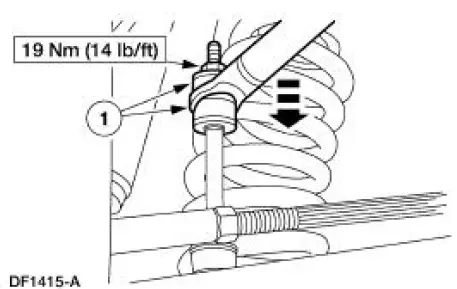
3. Disconnect the front stabilizer bar links (5K483) from the front stabilizer bar (5482).
1. Remove the nuts and bushings. Discard the nuts.
2. Rotate the stabilizer bar to disconnect the links.
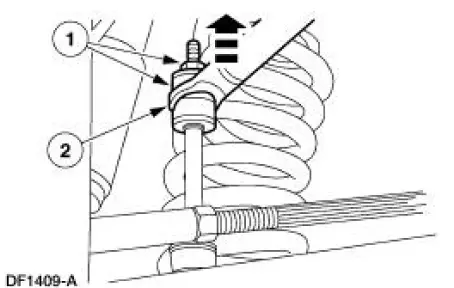
4. Remove and discard the nuts.
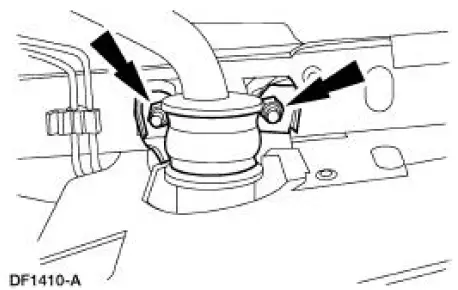
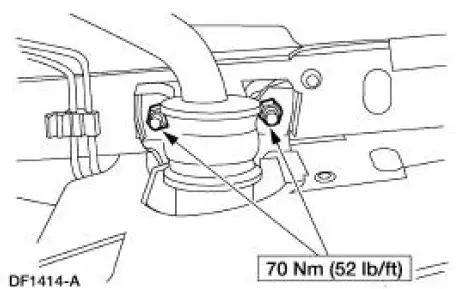
5. Remove the stabilizer bar brackets (5486) and the stabilizer bar mounting bracket adapters (5B482).
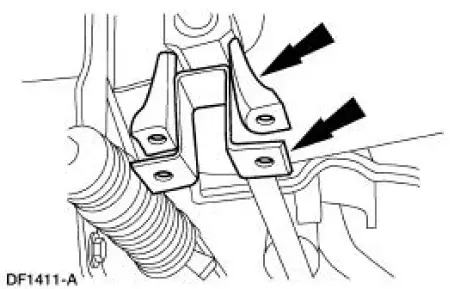
6. Remove the stabilizer bar.
7. If necessary, cut the stabilizer bar insulators (5493) from the stabilizer bar.
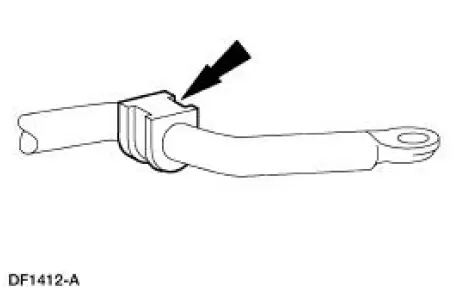
Installation
1. NOTE: To aid installation, coat the necessary parts of the front stabilizer bar and the inside diameter of the stabilizer bar bushing with Rubber Suspension Insulator Lube E25Y-19553-A or equivalent meeting Ford specification ESF-M99B112-A.
To install, reverse the removal procedure.
 Arm - Lower
Removal
CAUTION: Suspension fasteners are critical parts because they affect
performance of vital
components and systems and their failure can result in major service expense. A
new part with
the sa ...
 Link - Stabilizer Bar
Removal
CAUTION: Suspension fasteners are critical parts because they affect
performance of vital
components and systems and their failure can result in major service expense. A
new part with
the sa ...
Other materials:
Oil Pump Screen and Pickup Tube
Removal and Installation
1. Remove the oil pan (6675). For additional information, refer to Oil
Pan in this section.
2. Remove the oil pump screen cover and tube (6622) and discard the gasket.
1. Remove the nut.
2. Remove the two bolts.
3. Remov ...
Battery (Removal and Installation)
Removal and Installation
WARNING: Batteries normally produce explosive gases which can
cause personal injury.
Therefore, do not allow flames, sparks or lighted substances to come
near the battery. When
charging or working near a battery, always sh ...
Starter Motor - 3.8L
Removal
WARNING: When servicing starter motor (11002) or carrying out other
underhood work in
the vicinity of the starter motor, be aware that the heavy gauge battery
input lead at the starter
solenoid (11390) is "electrically hot" at all times. A prote ...
