
Ford Mustang (1999-2004) Service Manual: Climate Control System - General Information
General Specifications
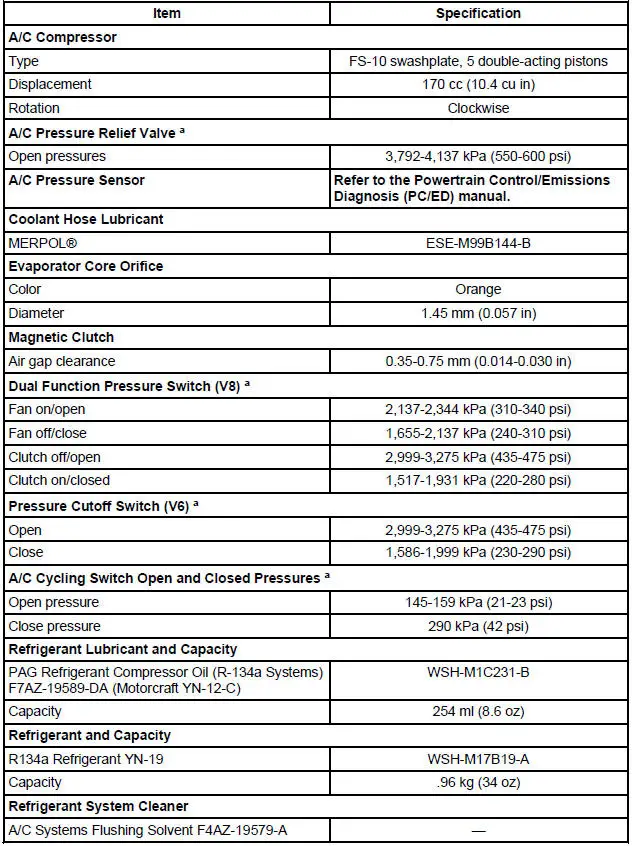
a - Manifold gauge set pressures may vary slightly depending on the distance between the service gauge port valve and the A/C pressure relief valve, the A/C cycling switch, the pressure cutoff switch (V6), and the dual function pressure switch (V8) location.
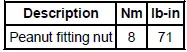
Torque Specifications
- Climate Control System (Description and Operation)
- Climate Control System (Diagnosis and Testing)
- Air Conditioning (A/C) System Check - Retail Procedure
- Spring Lock Coupling
- Heater Hose Coupling
- Air Conditioning Line (Peanut) Fitting
- Refrigerant System Tests
- Manifold Gauge Set Connection
- Electronic Leak Detection
- Tracer Dye Leak Detection
- Air Conditioning (A/C) System Flushing
- Air Conditioning (A/C) System Recovery, Evacuation and Charging
- Refrigerant System Filtering Following Air Conditioning (A/C) Component Installation
- Refrigerant Oil Adding
- Inspection and Assembly Requirements - Following an A/C Compressor Failure
- Refrigerant Identification Testing
- Contaminated Refrigerant Handling
- Vacuum Hose Repair - Mini-Tube

 Climate Control System (Description and Operation)
WARNING: To avoid accidental deployment and possible injury, the air
bag system
backup power supply must be depleted before repairing any climate control
components. To
deplete the backup power supp ...
Other materials:
Windshield wipers
Note: Fully defrost the windshield before switching on the windshield
wipers.
Note: Make sure you switch off the windshield wipers before entering a
car wash.
Note: Clean the windshield and wiper blades if they begin to leave
streaks or smears. If that does ...
Engine - 3.8L
General Specifications
a - 20-200 seconds to leakdown 3.18 mm (0.125 in) with 225 Newtons (50
pounds) load and tappet filled
with leak-down fluid.
Torque Specifications
a - Refer to the procedure in this section
b - Advance one-half turn aft ...
Caliper (DISASSEMBLY AND ASSEMBLY)
Disassembly
1. Remove the disc brake caliper (2B120). For additional information,
refer to Caliper in this
section.
2. Drain the remaining brake fluid from disc brake caliper.
3. Apply low air pressure to the fluid port in the disc brake caliper.
...
