
Ford Mustang (1999-2004) Service Manual: Anti-Theft - PATS
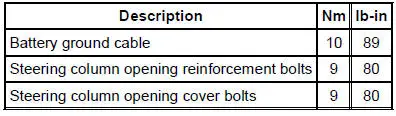
Torque Specifications
- Anti-Theft - Passive Anti-Theft System (PATS) (Description and Operation)
- Anti-Theft - Passive Anti-Theft System (PATS) (Diagnosis and Testing)
- Key Programming - Erase All Key Codes and Program Two Keys
- Key Programming - Program a Key Using Two Programmed Keys
- Key Programming - Enable/Disable Spare Key Programming
- Key Programming - Additional Key With One Programmed Key
- Security Access - Procedure
- Module - Passive Anti-Theft Transceiver

 Anti-Theft - Passive Anti-Theft System (PATS) (Description and Operation)
The passive anti-theft system (PATS) contains the following components:
theft indicator
encoded ignition key
transceiver module
instrument cluster
powertrain control module (PCM)
standard corpo ...
Other materials:
Brake Caliper Anchor Plate
Removal
1. Remove the pads. For additional information, refer to Pads in this
section.
2. Remove the anchor plate (2B292).
1. Remove and discard the anchor plate bolts.
2. Remove the anchor plate.
Installation
1. CAUTION: Use correct t ...
Pinpoint Tests - OSC Equipped Vehicles
Special Tool(s)
Breakout Box, EEC-V Control
System
418-049 (T94L-50-EEC-V) or
equivalent
MLP-TR Cable
418-F107 (007-00111) or
equivalent
Worldwide Diagnostic System
(WDS)
418-F224
New Generation STAR (NGS)
T ...
Water Pump - 3.8L
Material
Item
Specification
Motorcraft Premium Gold
Engine Coolant
VC-7-A (in Oregon VC-7-B)
(yellow color)
WSS-M97B51-
A1
Removal and Installation
1. Drain the engine coolant. For additional information, refer to Cooling
System Dra ...
