
Ford Mustang (1999-2004) Service Manual: Electronic Engine Controls
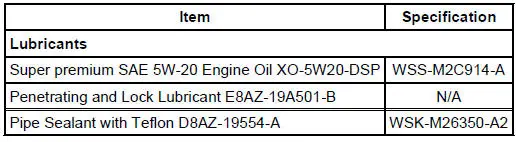
General Specifications
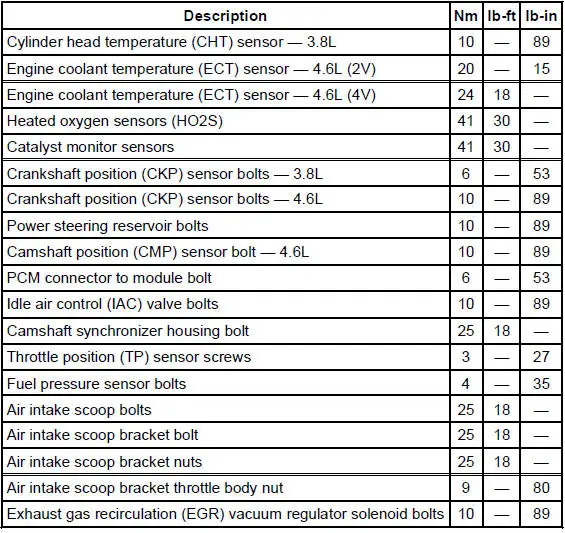
Torque Specifications
- Electronic Engine Controls (Description and Operation)
- Electronic Engine Controls - Cobra
- Temperature and Manifold Absolute Pressure (T-MAP) Sensor - Cobra
- Camshaft Position (CMP) Sensor - 3.8L
- Camshaft Position (CMP) Sensor - 4.6L
- Intake Manifold Runner Control (IMRC) Actuator - 3.8L
- Crankshaft Position (CKP) Sensor - 3.8L
- Crankshaft Position (CKP) Sensor - 4.6L
- Powertrain Control Module (PCM)
- Throttle Position (TP) Sensor
- Idle Air Control (IAC) Valve - 3.8L
- Idle Air Control (IAC) Valve - 4.6L (2V)
- Idle Air Control (IAC) Valve - Cobra
- Idle Air Control (IAC) Valve - Mach I
- Cylinder Head Temperature (CHT) Sensor - 3.8L
- Engine Coolant Temperature (ECT) Sensor - 4.6L (2V)
- Engine Coolant Temperature (ECT) Sensor - Cobra
- Engine Coolant Temperature (ECT) Sensor - Mach I
- Mass Air Flow (MAF) Sensor - 3.8L
- Mass Air Flow (MAF) Sensor - 4.6L (2V)
- Mass Air Flow (MAF) Sensor - Cobra
- Mass Air Flow (MAF) Sensor - Mach I
- Heated Oxygen Sensor (HO2S)
- Catalyst Monitor Sensor
- Clutch Pedal Position (CPP) Switch
- Fuel Pressure Sensor
- Supercharger Bypass Vacuum Solenoid - Actuator
 Evaporative Emission Test Port
Removal and Installation
1. Disconnect the pin-type retainer.
2. Raise and support the vehicle. For additional information, refer to
Section.
3. Remove the RH front wheel. For additional informa ...
 Electronic Engine Controls (Description and Operation)
The electronic engine controls consist of the following:
powertrain control module (PCM)
throttle position (TP) sensor
idle air control (IAC) valve
engine coolant temperature (ECT) sens ...
Other materials:
System Air Flow Description
MAX A/C
When MAX A/C is selected:
The air inlet door vacuum control motor is at full vacuum, closing
off outside air and admitting
only recirculated air.
The panel/defrost door vacuum control motor is at full vacuum and
the panel/floor door vacu ...
Starter Motor - 3.8L
Removal
WARNING: When servicing starter motor (11002) or carrying out other
underhood work in
the vicinity of the starter motor, be aware that the heavy gauge battery
input lead at the starter
solenoid (11390) is "electrically hot" at all times. A prote ...
Drive Pinion Flange
Special Tool(s)
2-Jaw Puller
205-D072 (D97L-4221-A) or
equivalent
Holding Fixture, Drive Pinion
Flange
205-126 (T78P-4851-A)
Installer, Drive Pinion Flange
205-002 (TOOL-4858-E) or
equivalent
...
